
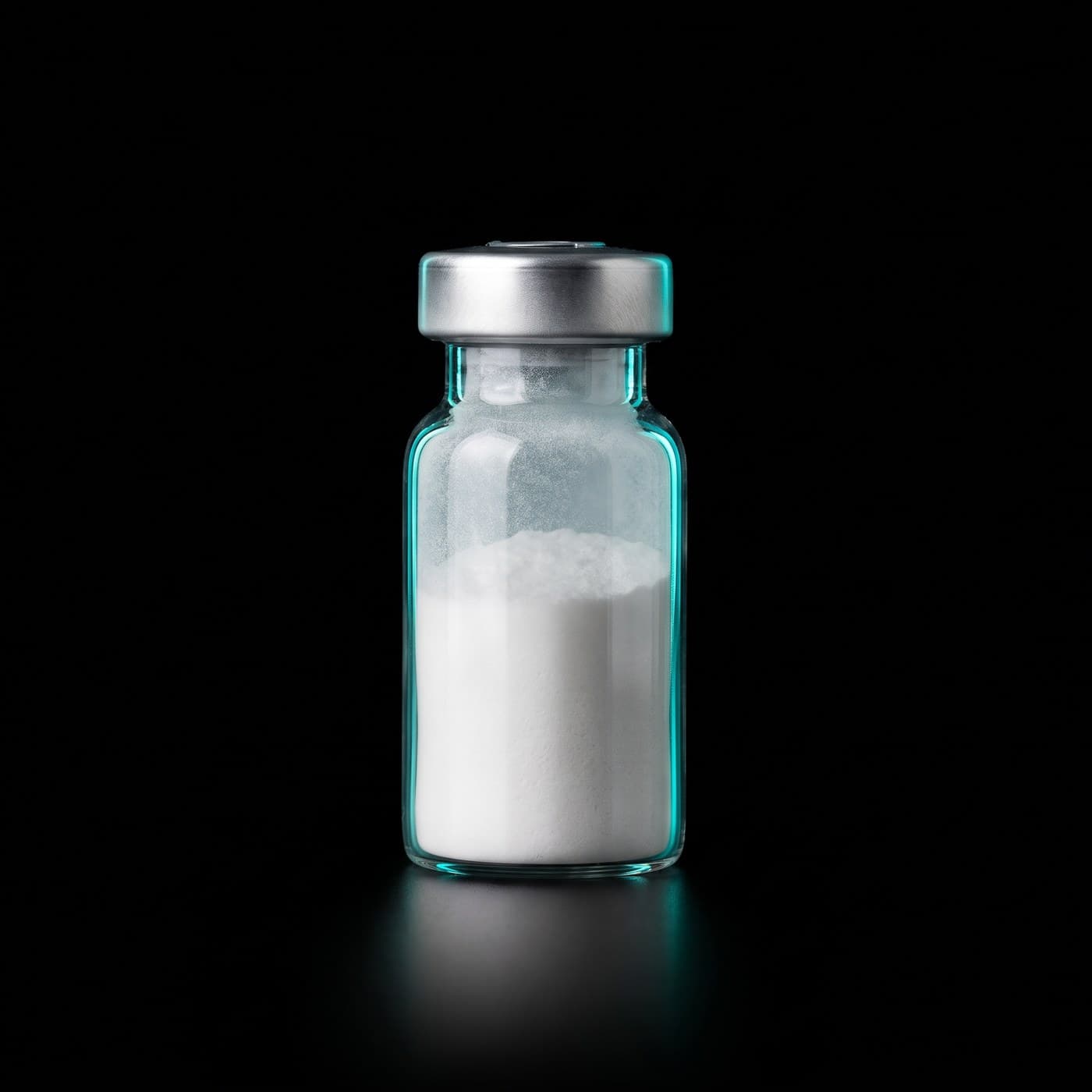
AOD-9604
A synthetic analogue of the C-terminal 176-191 region of human growth hormone, studied separately from the intact hormone.
- Purity
- 99.2%
- Lot
- PU-3887
- CAS
- 221231-10-3
- MW
- 1815.07 g/mol
- Format
- Lyophilized powder
- Third-party tested
- Discreet packaging
- Same-day shipping
- Encrypted checkout
For research use only. Not for human consumption.
Mechanism of Action
AOD-9604 corresponds to the C-terminal 176-191 fragment of human growth hormone with an added tyrosine. The rationale for studying the fragment separately dates to 1978 work in the American Journal of Physiology on the activity of synthetic C-terminal fragments of the hormone, which reported effects distinct from those of the intact molecule.
The fragment does not carry the growth-hormone receptor binding determinants of the intact hormone; structure-function studies of human growth hormone have mapped which substitutions affect secondary structure and receptor binding, and the C-terminal region is not the primary receptor interface.
Research Findings
A 2004 profile in Current Opinion in Investigational Drugs summarised the early development programme. A 2015 study in the Annals of Clinical and Laboratory Science examined intra-articular administration with and without hyaluronic acid in a rabbit osteoarthritis model, and 2015 analytical work characterised in vitro metabolism of the peptide.
More recent work has used the fragment as a targeting element in a chitosan drug-delivery construct rather than as an agent in its own right. The independent primary literature on this compound remains small.
Storage & Reconstitution
Sealed lyophilized vials are stored in the dark. The peptide-formulation literature regards the dry solid as the stable state and the solution as the fragile one: refrigeration at 2-8 degrees C is standard for short holding periods, and minus 20 degrees C or colder for long-term storage. Vials are brought to room temperature before opening so that atmospheric moisture does not condense onto the cold solid.
For reconstitution, the diluent is added slowly down the inner wall of the vial rather than directly onto the cake, and the vial is swirled rather than shaken - agitation at an air-liquid interface is a well-documented driver of peptide aggregation. The solid should dissolve to a clear, particle-free solution; persistent cloudiness or visible particulate indicates the material should not be used.
Reconstituted solution is held at 2-8 degrees C and protected from light. Freeze-thaw cycling is the single most avoidable cause of loss, so where a solution must be frozen it is aliquoted first into single-use volumes. Working aliquots are labelled with the lot number so that any result can be traced back to the certificate of analysis for that lot.
- Physical form
- Lyophilized powder, sealed vial
- Sealed storage
- 2-8 C short term / -20 C long term
- Reconstituted
- 2-8 C, protected from light
- Diluent
- Bacteriostatic water, added down the vial wall
- Avoid
- Shaking, freeze-thaw cycling, direct light
Handling summary
References
Every entry below links to its PubMed record. Publication is not endorsement: several of these papers report limitations, negative findings or adverse events, and they are listed for that reason.
- [1]
- [2]AOD-9604 Metabolic(opens PubMed in a new tab)
Curr Opin Investig Drugs · 2004 · PMID 15134286
- [3]Hyperglycemic action of synthetic C-terminal fragments of human growth hormone(opens PubMed in a new tab)
Am J Physiol · 1978 · PMID 645904
- [4]Amino acid substitutions in human growth hormone affect secondary structure and receptor binding(opens PubMed in a new tab)
PLoS One · 2023 · PMID 36952491
- [5]Effect of Intra-articular Injection of AOD9604 with or without Hyaluronic Acid in Rabbit Osteoarthritis Model(opens PubMed in a new tab)
Ann Clin Lab Sci · 2015 · PMID 26275694
- [6]Growth hormone isoforms and segments/fragments: molecular structure and laboratory measurement(opens PubMed in a new tab)
Clin Chim Acta · 2006 · PMID 16194529