
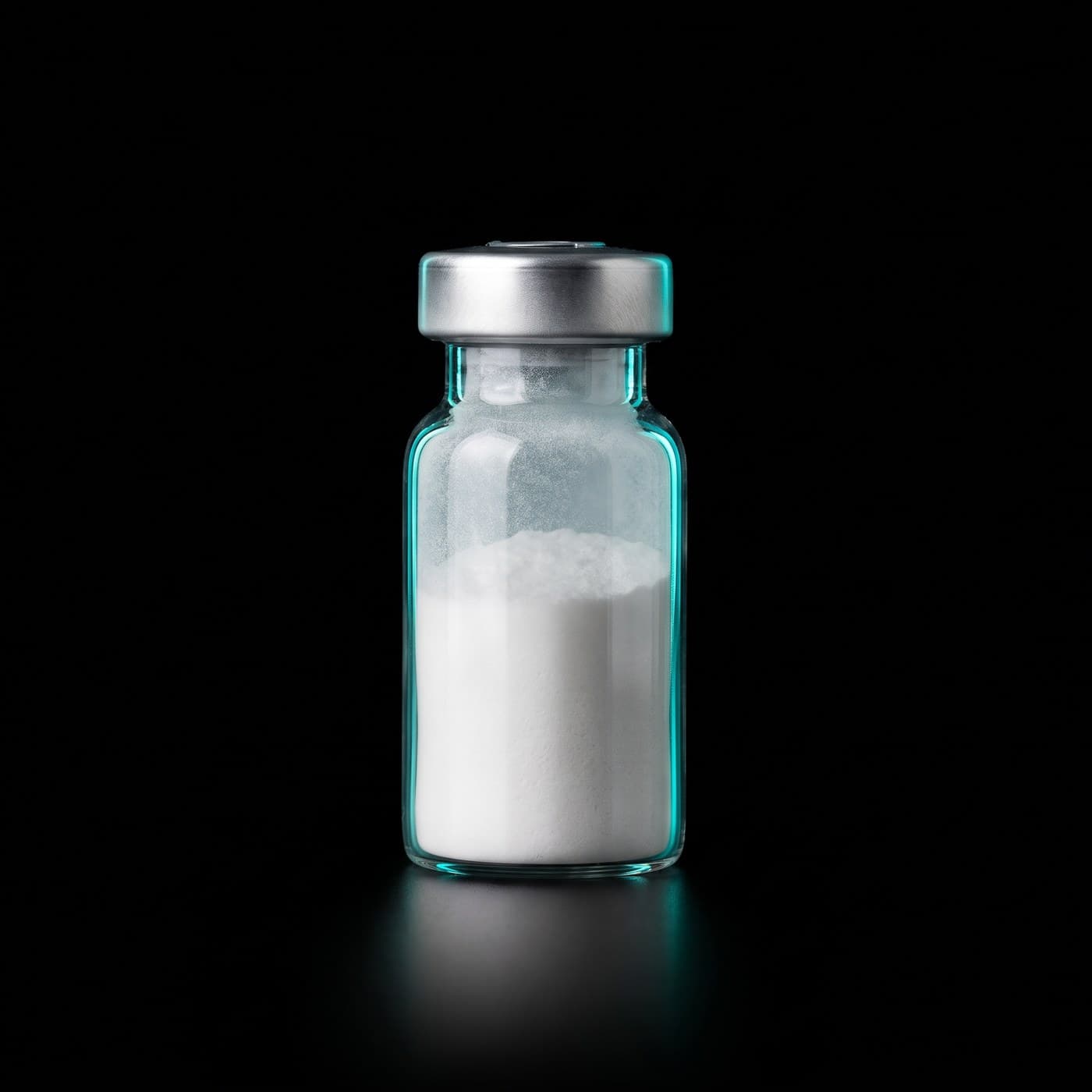
ARA-290
An 11-residue peptide, also called cibinetide, engineered from erythropoietin to engage the innate repair receptor without erythropoietic activity.
- Purity
- 99.2%
- Lot
- PU-56D2
- CAS
- 1208243-50-8
- MW
- 1258.42 g/mol
- Format
- Lyophilized powder
- Third-party tested
- Discreet packaging
- Same-day shipping
- Encrypted checkout
For research use only. Not for human consumption.
Mechanism of Action
ARA 290 is a short peptide derived from the helix B region of erythropoietin. It was engineered specifically to engage the heteromeric EPO receptor-beta common receptor complex - the innate repair receptor - while lacking affinity for the homodimeric receptor that drives erythropoiesis.
A 2018 study in Biochimica et Biophysica Acta characterised activation of that receptor complex directly. The design intent is the mechanistically interesting part of this compound: it separates tissue-protective signalling from the haematopoietic effect that limits erythropoietin itself.
Research Findings
Clinical work has examined small fiber neuropathy in sarcoidosis, reviewed in Expert Opinion on Investigational Drugs in 2014, with corneal nerve fibre measurement used as an objective endpoint in a 2018 Scientific Reports study.
Preclinical work covers islet allograft function, macrophage activation in transplantation models, experimental colitis, an Alzheimer's disease model in Brain Behavior and Immunity, and osteoclastogenesis. A 2016 Peptides study examined TRPV1 channel involvement in pain signalling.
Storage & Reconstitution
Sealed lyophilized vials are stored in the dark. The peptide-formulation literature regards the dry solid as the stable state and the solution as the fragile one: refrigeration at 2-8 degrees C is standard for short holding periods, and minus 20 degrees C or colder for long-term storage. Vials are brought to room temperature before opening so that atmospheric moisture does not condense onto the cold solid.
For reconstitution, the diluent is added slowly down the inner wall of the vial rather than directly onto the cake, and the vial is swirled rather than shaken - agitation at an air-liquid interface is a well-documented driver of peptide aggregation. The solid should dissolve to a clear, particle-free solution; persistent cloudiness or visible particulate indicates the material should not be used.
Reconstituted solution is held at 2-8 degrees C and protected from light. Freeze-thaw cycling is the single most avoidable cause of loss, so where a solution must be frozen it is aliquoted first into single-use volumes. Working aliquots are labelled with the lot number so that any result can be traced back to the certificate of analysis for that lot.
- Physical form
- Lyophilized powder, sealed vial
- Sealed storage
- 2-8 C short term / -20 C long term
- Reconstituted
- 2-8 C, protected from light
- Diluent
- Bacteriostatic water, added down the vial wall
- Avoid
- Shaking, freeze-thaw cycling, direct light
Handling summary
References
Every entry below links to its PubMed record. Publication is not endorsement: several of these papers report limitations, negative findings or adverse events, and they are listed for that reason.
- [1]ARA 290 for treatment of small fiber neuropathy in sarcoidosis(opens PubMed in a new tab)
Expert Opin Investig Drugs · 2014 · PMID 24555851
- [2]
- [3]Improvement of Islet Allograft Function Using Cibinetide, an Innate Repair Receptor Ligand(opens PubMed in a new tab)
Transplantation · 2020 · PMID 32345869
- [4]Activation of the EPOR-β common receptor complex by cibinetide ameliorates impaired wound healing in mice with genetic diabetes(opens PubMed in a new tab)
Biochim Biophys Acta Mol Basis Dis · 2018 · PMID 29223734
- [5]The protective effect of erythropoietin and its novel derived peptides in peripheral nerve injury(opens PubMed in a new tab)
Int Immunopharmacol · 2024 · PMID 38943972
- [6]ARA290 inhibits high glucose-induced apoptosis of NRK-52E cells(opens PubMed in a new tab)
J Biol Regul Homeost Agents · 2021 · PMID 34134477