
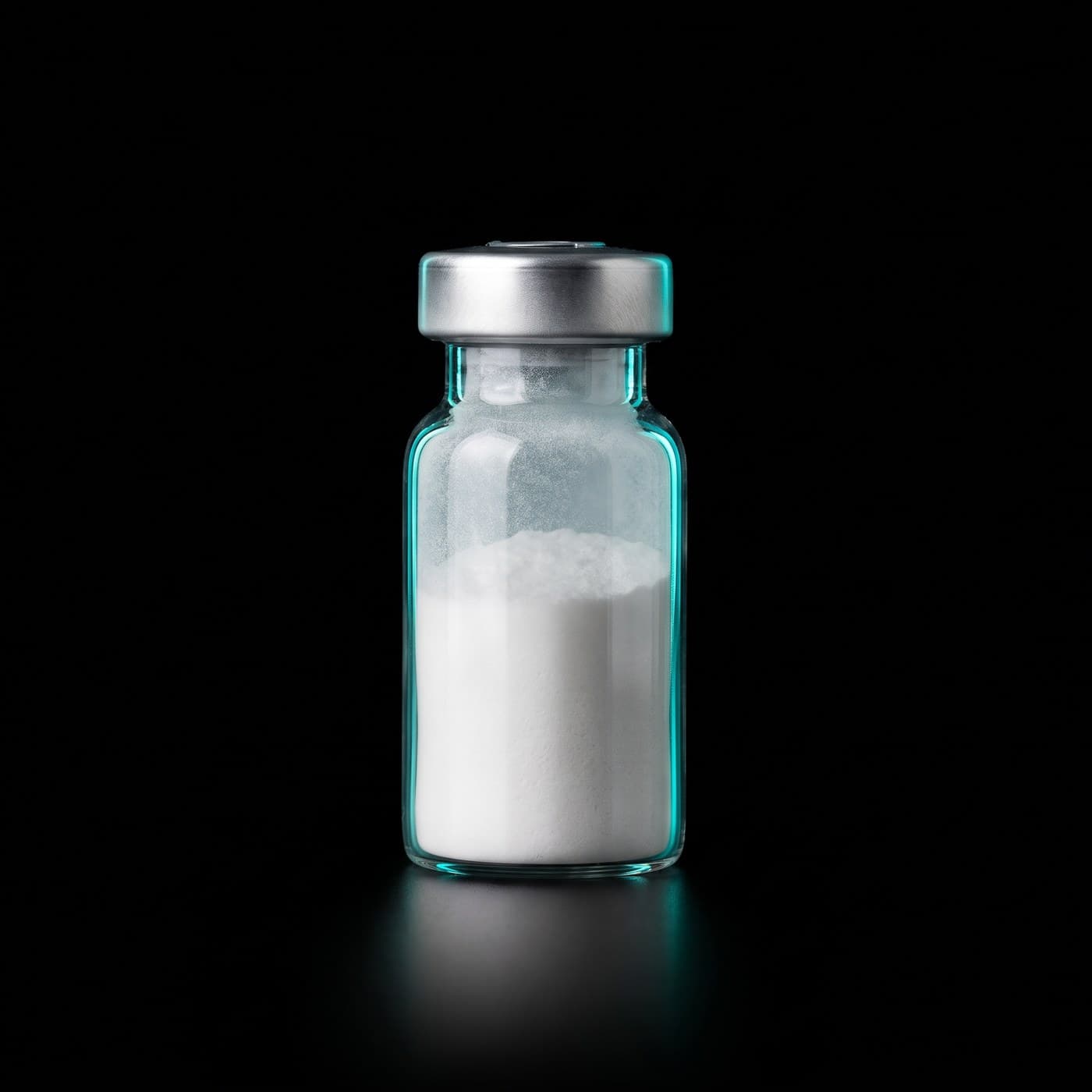
Bacteriostatic Water
Sterile water containing 0.9% benzyl alcohol as a bacteriostatic preservative, used to reconstitute lyophilized peptides for multiple withdrawals.
- Purity
- 99.2%
- Lot
- PU-7D1E
- Format
- Preserved diluent
- Third-party tested
- Discreet packaging
- Same-day shipping
- Encrypted checkout
For research use only. Not for human consumption.
Mechanism of Action
Bacteriostatic water is a laboratory diluent, not a research compound, and has no pharmacological mechanism. It is sterile water containing benzyl alcohol at approximately 0.9% as an antimicrobial preservative, which suppresses microbial growth in a container subject to repeated withdrawals.
Its relevance to peptide work is a formulation question. A 2021 study in the Journal of Pharmaceutical Sciences reported antimicrobial-excipient-induced reversible association of therapeutic peptides in parenteral formulations, and a 2022 paper in Molecular Pharmaceutics examined the molecular mechanism of that aggregation. The preservative is not inert with respect to the dissolved peptide.
Research Findings
The relevant indexed literature is formulation science: a 2007 Journal of Pharmaceutical Sciences review of antimicrobial preservative use in parenteral products, a 2023 Pharmaceutics overview of preservatives for protein and peptide formulations, and a 2017 International Journal of Toxicology safety assessment of benzyl alcohol and its relatives.
Comparative work has examined preserved saline as a diluent in other contexts. These are class-level references appropriate to a consumable; there is no product-specific literature and none is implied.
Storage & Reconstitution
Sealed bottles are stored at controlled room temperature and protected from light; refrigeration is not required and the diluent is not frozen. Benzyl alcohol is the preservative, and freezing a preserved aqueous solution risks phase separation of the preservative from the water.
The stopper is wiped with 70 percent isopropyl alcohol before each withdrawal and allowed to dry. The preservative is bacteriostatic, not sterilising: it suppresses growth of organisms introduced during withdrawal, but it does not make a contaminated container safe. A single needle is not reused across containers.
Note the interaction documented in the references above: antimicrobial excipients can induce reversible association of dissolved peptides. Where a peptide is known to be aggregation-prone, preservative-free sterile water is used for a single-withdrawal preparation instead, and the choice recorded with the experiment.
- Physical form
- Sterile water, 0.9% benzyl alcohol
- Sealed storage
- Controlled room temperature
- Septum
- Swab with 70% IPA, allow to dry
- Function
- Bacteriostatic, not sterilising
- Avoid
- Freezing, reused needles
Handling summary
References
No indexed literature exists for this item specifically. The entries below are class-level references on peptide formulation, delivery and handling, listed as background rather than as evidence about this product.
- [1]Antimicrobial preservative use in parenteral products: past and present(opens PubMed in a new tab)
J Pharm Sci · 2007 · PMID 17722087
- [2]Bacteriostatic preserved saline for pain-free periocular injections: review(opens PubMed in a new tab)
Eye (Lond) · 2022 · PMID 35017698
- [3]Antimicrobial Excipient-Induced Reversible Association of Therapeutic Peptides in Parenteral Formulations(opens PubMed in a new tab)
J Pharm Sci · 2021 · PMID 32980392
- [4]Safety Assessment of Benzyl Alcohol, Benzoic Acid and its Salts, and Benzyl Benzoate(opens PubMed in a new tab)
Int J Toxicol · 2017 · PMID 29243541
- [5]Antimicrobial Preservatives for Protein and Peptide Formulations: An Overview(opens PubMed in a new tab)
Pharmaceutics · 2023 · PMID 36839885
- [6]