
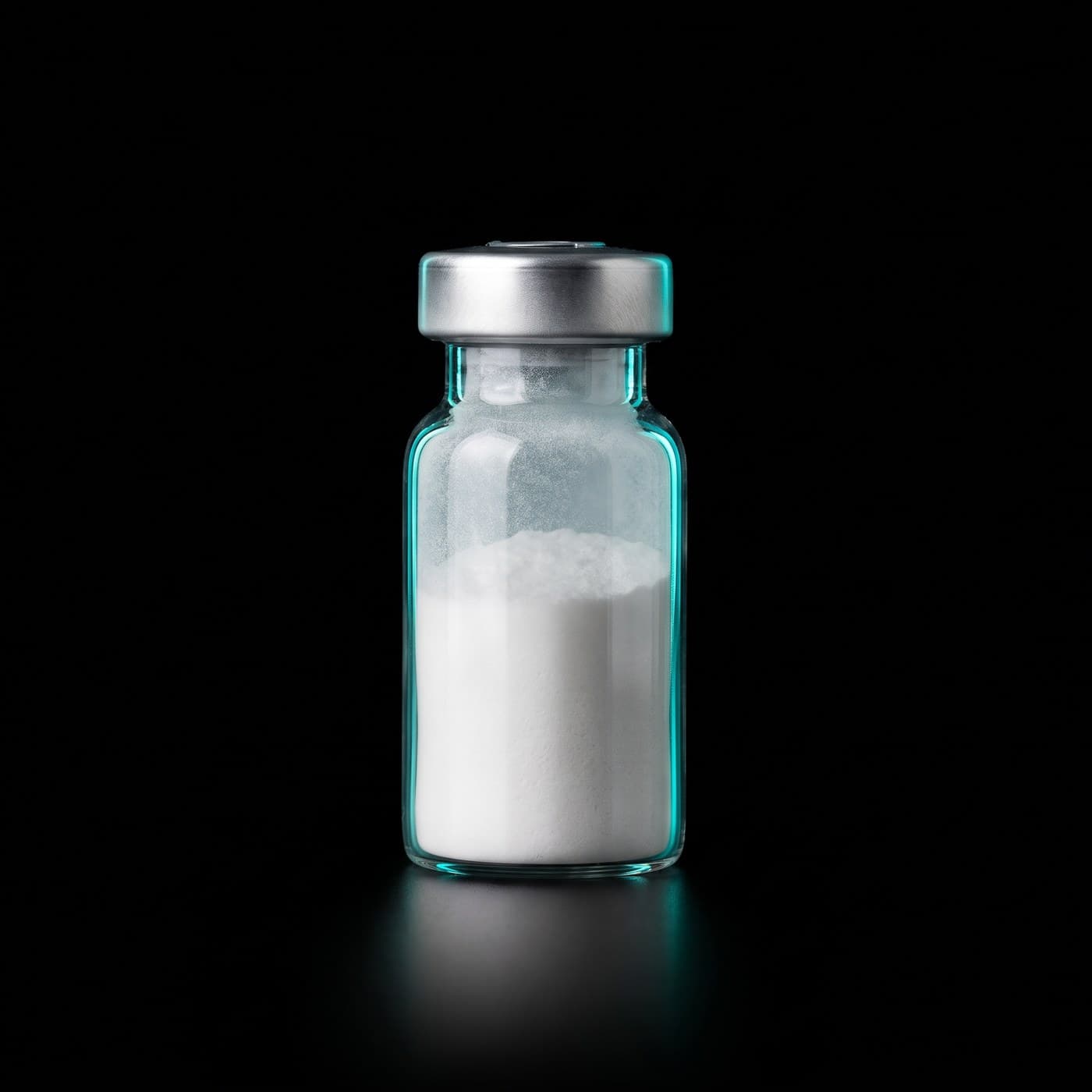
BPC-157
A synthetic 15-amino-acid sequence derived from a protein fragment found in human gastric juice, studied preclinically for its role in tissue-repair signalling.
- Purity
- 99.2%
- Lot
- PU-38D6
- CAS
- 137525-51-0
- MW
- 1419.53 g/mol
- Format
- Lyophilized powder
- Third-party tested
- Discreet packaging
- Same-day shipping
- Encrypted checkout
For research use only. Not for human consumption.
Mechanism of Action
BPC-157 is a synthetic pentadecapeptide corresponding to a partial sequence of body protection compound, a protein fragment identified in human gastric juice. No dedicated high-affinity receptor has been established for it. The published mechanistic account instead describes it as modulating pathways already active during tissue repair.
Preclinical reports have associated it with the nitric oxide system and with growth-factor signalling linked to angiogenesis, including work on VEGFR2 activation and downstream FAK-paxillin signalling in endothelial models. Separate rodent studies have examined interactions with dopaminergic and serotonergic systems. Reviewers have noted that the breadth of reported activity is itself a reason for caution.
Research Findings
The evidence base is preclinical. Published studies have used rodent models of tendon, ligament, muscle, gastrointestinal and ocular injury, together with ex vivo tendon explant work, reporting histological and cell-outgrowth endpoints under each laboratory's conditions.
Systematic and narrative reviews published between 2019 and 2026 have converged on the same limitation: the primary literature is dominated by a small number of groups, model systems vary widely, and controlled human trials have not been reported. A 2026 formulation review additionally examined the biopharmaceutical obstacles to developing the peptide as a defined product.
Storage & Reconstitution
Sealed lyophilized vials are stored in the dark. The peptide-formulation literature regards the dry solid as the stable state and the solution as the fragile one: refrigeration at 2-8 degrees C is standard for short holding periods, and minus 20 degrees C or colder for long-term storage. Vials are brought to room temperature before opening so that atmospheric moisture does not condense onto the cold solid. Lyophilized BPC-157 has been described in the formulation literature as comparatively robust as a dry solid, with the reconstituted solution the more fragile state.
For reconstitution, the diluent is added slowly down the inner wall of the vial rather than directly onto the cake, and the vial is swirled rather than shaken - agitation at an air-liquid interface is a well-documented driver of peptide aggregation. The solid should dissolve to a clear, particle-free solution; persistent cloudiness or visible particulate indicates the material should not be used.
Reconstituted solution is held at 2-8 degrees C and protected from light. Freeze-thaw cycling is the single most avoidable cause of loss, so where a solution must be frozen it is aliquoted first into single-use volumes. Working aliquots are labelled with the lot number so that any result can be traced back to the certificate of analysis for that lot.
- Physical form
- Lyophilized powder, sealed vial
- Sealed storage
- 2-8 C short term / -20 C long term
- Reconstituted
- 2-8 C, protected from light
- Diluent
- Bacteriostatic water, added down the vial wall
- Avoid
- Shaking, freeze-thaw cycling, direct light
Handling summary
References
Every entry below links to its PubMed record. Publication is not endorsement: several of these papers report limitations, negative findings or adverse events, and they are listed for that reason.
- [1]Multifunctionality and Possible Medical Application of the BPC 157 Peptide-Literature and Patent Review(opens PubMed in a new tab)
Pharmaceuticals (Basel) · 2025 · PMID 40005999
- [2]Gastric pentadecapeptide body protection compound BPC 157 and its role in accelerating musculoskeletal soft tissue healing(opens PubMed in a new tab)
Cell Tissue Res · 2019 · PMID 30915550
- [3]Stable Gastric Pentadecapeptide BPC 157 and Wound Healing(opens PubMed in a new tab)
Front Pharmacol · 2021 · PMID 34267654
- [4]Emerging Use of BPC-157 in Orthopaedic Sports Medicine: A Systematic Review(opens PubMed in a new tab)
HSS J · 2025 · PMID 40756949
- [5]
- [6]Pentadecapeptide BPC 157 and the central nervous system(opens PubMed in a new tab)
Neural Regen Res · 2022 · PMID 34380875