
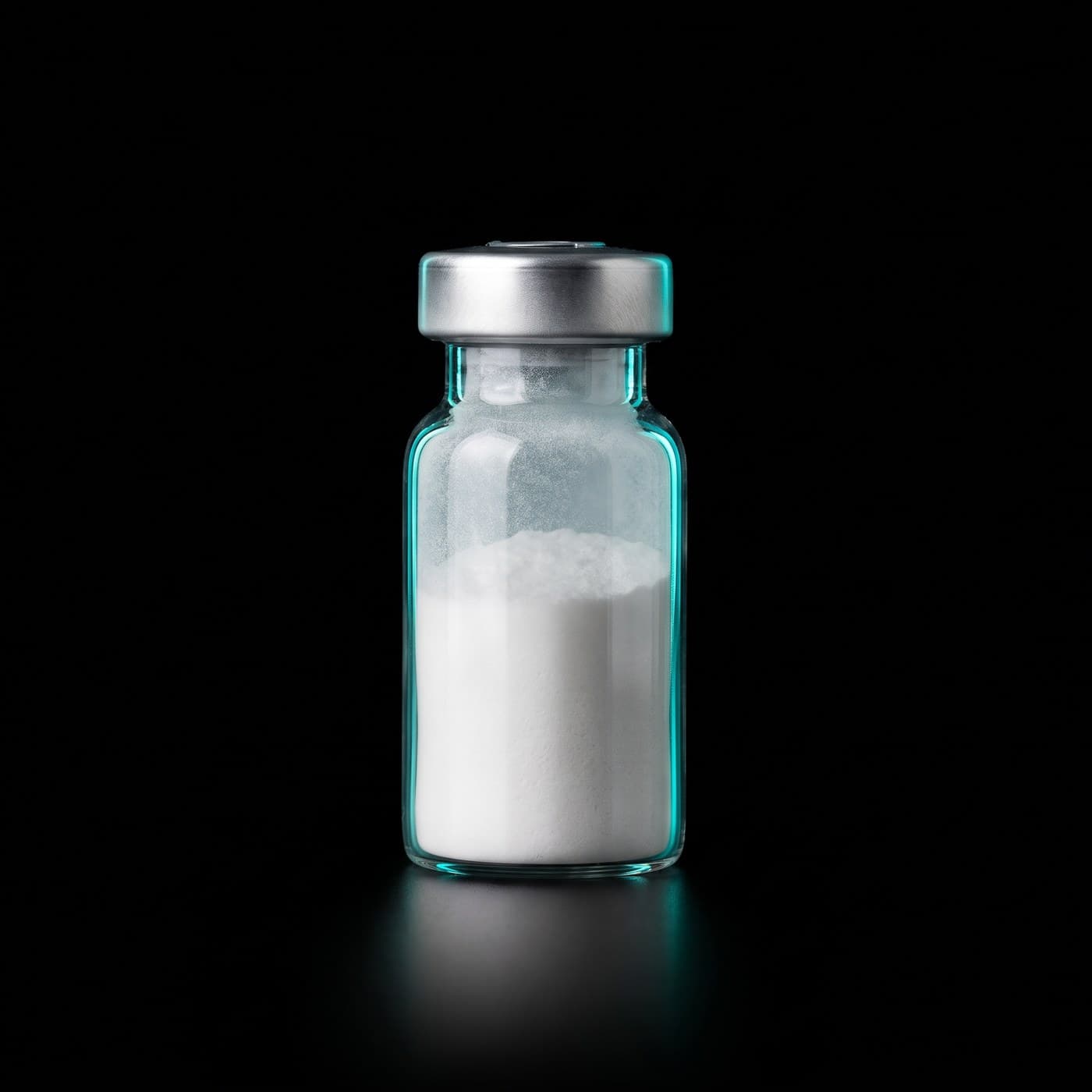
CJC (no DAC)
A modified growth-hormone-releasing hormone fragment corresponding to the first 29 residues of GHRH, without the drug-affinity complex that extends half-life.
- Purity
- 99.2%
- Lot
- PU-E53F
- Format
- Lyophilized powder
- Third-party tested
- Discreet packaging
- Same-day shipping
- Encrypted checkout
For research use only. Not for human consumption.
Mechanism of Action
The active core of growth-hormone-releasing hormone is contained in its first 29 residues. Analogues in this family engage the GHRH receptor on pituitary somatotrophs and amplify the pulsatile release of growth hormone rather than replacing the hormone directly.
The published contrast in this class is between analogues carrying a drug-affinity complex, which binds serum albumin and extends the circulating half-life to days, and those without it, whose action is short. Studies published in 2005 and 2006 characterised the albumin-conjugated form specifically, and that comparison defines what a preparation lacking the linker is expected to do.
Research Findings
Human pharmacology studies published in the Journal of Clinical Endocrinology and Metabolism reported the secretory profile of the long-acting analogue, including whether pulsatility persists under continuous stimulation. Endocrinology work characterised receptor activation by the bioconjugate.
Analytical chemistry for GHRH analogues has developed alongside the pharmacology, and recent orthopaedic and sports-medicine reviews survey the class critically. The record for the non-conjugated form is thinner than for the conjugated one.
Storage & Reconstitution
Sealed lyophilized vials are stored in the dark. The peptide-formulation literature regards the dry solid as the stable state and the solution as the fragile one: refrigeration at 2-8 degrees C is standard for short holding periods, and minus 20 degrees C or colder for long-term storage. Vials are brought to room temperature before opening so that atmospheric moisture does not condense onto the cold solid.
For reconstitution, the diluent is added slowly down the inner wall of the vial rather than directly onto the cake, and the vial is swirled rather than shaken - agitation at an air-liquid interface is a well-documented driver of peptide aggregation. The solid should dissolve to a clear, particle-free solution; persistent cloudiness or visible particulate indicates the material should not be used.
Reconstituted solution is held at 2-8 degrees C and protected from light. Freeze-thaw cycling is the single most avoidable cause of loss, so where a solution must be frozen it is aliquoted first into single-use volumes. Working aliquots are labelled with the lot number so that any result can be traced back to the certificate of analysis for that lot.
- Physical form
- Lyophilized powder, sealed vial
- Sealed storage
- 2-8 C short term / -20 C long term
- Reconstituted
- 2-8 C, protected from light
- Diluent
- Bacteriostatic water, added down the vial wall
- Avoid
- Shaking, freeze-thaw cycling, direct light
Handling summary
References
Every entry below links to its PubMed record. Publication is not endorsement: several of these papers report limitations, negative findings or adverse events, and they are listed for that reason.
- [1]
- [2]Pulsatile secretion of growth hormone (GH) persists during continuous stimulation by CJC-1295, a long-acting GH-releasing hormone analog(opens PubMed in a new tab)
J Clin Endocrinol Metab · 2006 · PMID 17018654
- [3]Once-daily administration of CJC-1295, a long-acting growth hormone-releasing hormone (GHRH) analog, normalizes growth in the GHRH knockout mouse(opens PubMed in a new tab)
Am J Physiol Endocrinol Metab · 2006 · PMID 16822960
- [4]
- [5]Activation of the GH/IGF-1 axis by CJC-1295, a long-acting GHRH analog, results in serum protein profile changes in normal adult subjects(opens PubMed in a new tab)
Growth Horm IGF Res · 2009 · PMID 19386527
- [6]Identification of CJC-1295, a growth-hormone-releasing peptide, in an unknown pharmaceutical preparation(opens PubMed in a new tab)
Drug Test Anal · 2010 · PMID 21204297