
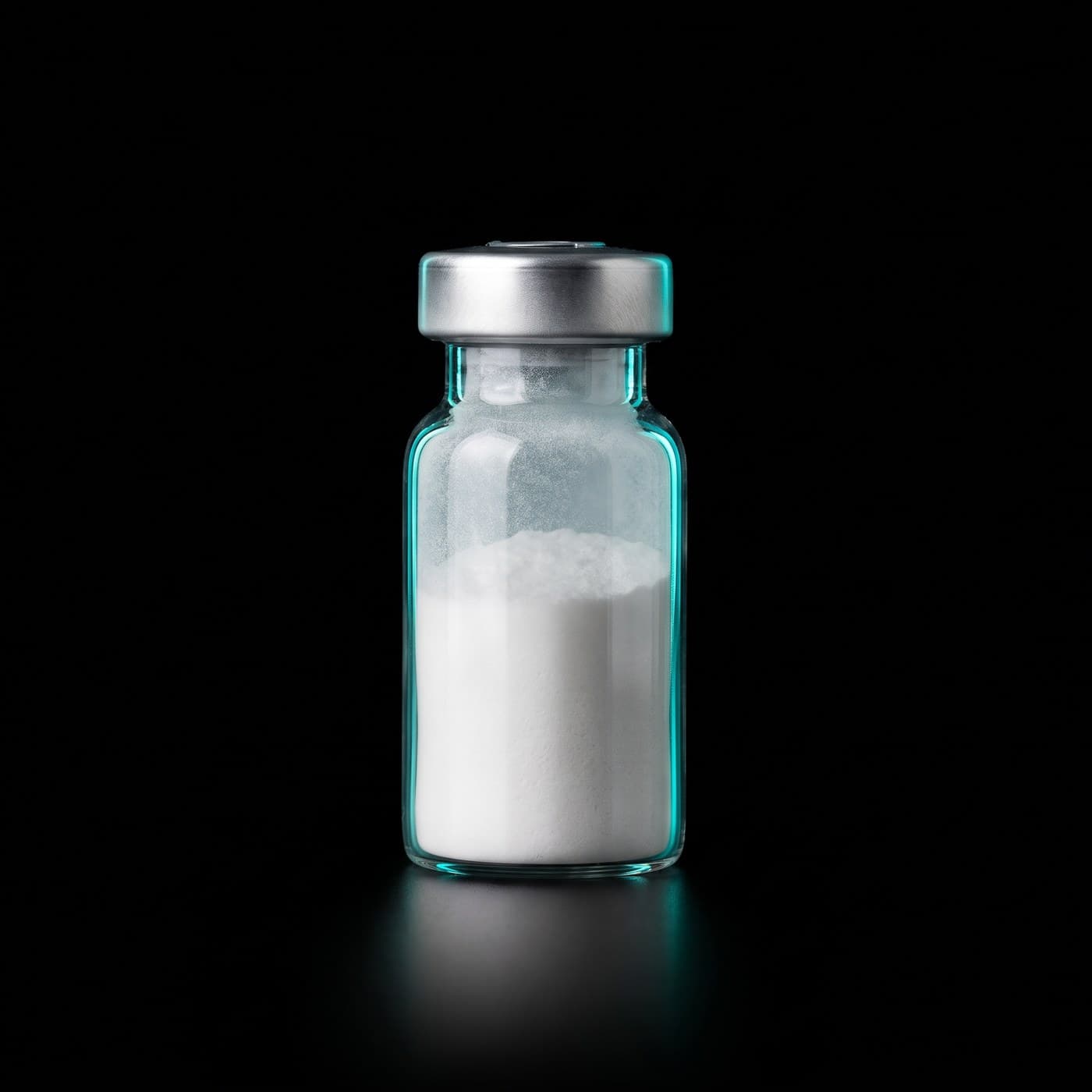
DSIP
A nonapeptide first isolated from rabbit cerebral venous blood during induced sleep, whose physiological role has remained unresolved for four decades.
- Purity
- 99.2%
- Lot
- PU-9A49
- CAS
- 62568-57-4
- MW
- 848.82 g/mol
- Format
- Lyophilized powder
- Third-party tested
- Discreet packaging
- Same-day shipping
- Encrypted checkout
For research use only. Not for human consumption.
Mechanism of Action
DSIP is a nonapeptide originally recovered from the cerebral venous blood of rabbits during electrically induced sleep. Despite that origin, no receptor has been identified and no consistent mechanism has been established - a 2006 review in the Journal of Neurochemistry described it explicitly as a still-unresolved riddle.
The reported activity profile in the literature is broad and poorly unified: effects on sleep architecture, anticonvulsant activity, stress-response modulation and, in a 2018 report, phosphorylated-DSIP effects on spatial memory and CREB phosphorylation in rodents.
Research Findings
Reviews spanning 1984 to 2006 in Neuroscience and Biobehavioral Reviews, Peptides and the Journal of Neurochemistry document repeated attempts to establish a coherent account and their limited success.
Individual studies have examined sleep in chronic insomnia in a double-blind design published in Neuropsychobiology, motor recovery after focal stroke in rats, and immunoreactivity in schizophrenia. Findings across these reports have not converged.
Storage & Reconstitution
Sealed lyophilized vials are stored in the dark. The peptide-formulation literature regards the dry solid as the stable state and the solution as the fragile one: refrigeration at 2-8 degrees C is standard for short holding periods, and minus 20 degrees C or colder for long-term storage. Vials are brought to room temperature before opening so that atmospheric moisture does not condense onto the cold solid.
For reconstitution, the diluent is added slowly down the inner wall of the vial rather than directly onto the cake, and the vial is swirled rather than shaken - agitation at an air-liquid interface is a well-documented driver of peptide aggregation. The solid should dissolve to a clear, particle-free solution; persistent cloudiness or visible particulate indicates the material should not be used.
Reconstituted solution is held at 2-8 degrees C and protected from light. Freeze-thaw cycling is the single most avoidable cause of loss, so where a solution must be frozen it is aliquoted first into single-use volumes. Working aliquots are labelled with the lot number so that any result can be traced back to the certificate of analysis for that lot.
- Physical form
- Lyophilized powder, sealed vial
- Sealed storage
- 2-8 C short term / -20 C long term
- Reconstituted
- 2-8 C, protected from light
- Diluent
- Bacteriostatic water, added down the vial wall
- Avoid
- Shaking, freeze-thaw cycling, direct light
Handling summary
References
Every entry below links to its PubMed record. Publication is not endorsement: several of these papers report limitations, negative findings or adverse events, and they are listed for that reason.
- [1]Delta sleep-inducing peptide(opens PubMed in a new tab)
Eur J Anaesthesiol · 2001 · PMID 11437870
- [2]Delta-sleep-inducing peptide (DSIP): a review(opens PubMed in a new tab)
Neurosci Biobehav Rev · 1984 · PMID 6145137
- [3]Delta sleep-inducing peptide (DSIP): a still unresolved riddle(opens PubMed in a new tab)
J Neurochem · 2006 · PMID 16539679
- [4]Delta-sleep-inducing peptide (DSIP): an update(opens PubMed in a new tab)
Peptides · 1986 · PMID 3550726
- [5]Delta Sleep-Inducing Peptide Recovers Motor Function in SD Rats after Focal Stroke(opens PubMed in a new tab)
Molecules · 2021 · PMID 34500605
- [6]Study of delta sleep-inducing peptide efficacy in improving sleep on short-term administration to chronic insomniacs(opens PubMed in a new tab)
Int J Clin Pharmacol Res · 1987 · PMID 3583493