
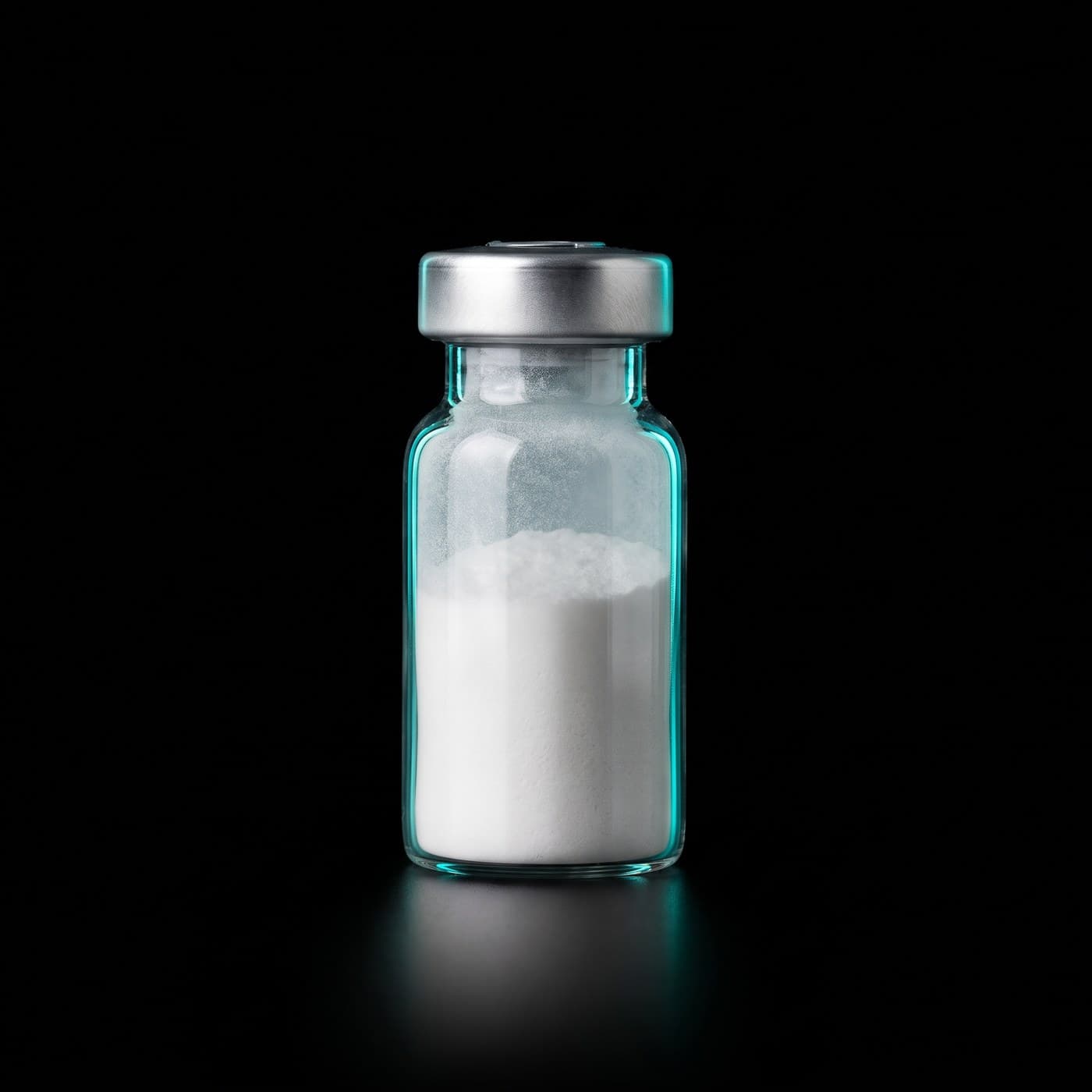
GLOW
A combined research preparation; each constituent has its own literature.
- Purity
- 99.2%
- Lot
- PU-CE4D
- Format
- Lyophilized powder
- Third-party tested
- Discreet packaging
- Same-day shipping
- Encrypted checkout
For research use only. Not for human consumption.
Mechanism of Action
This preparation combines GHK-Cu, BPC-157 and TB-500. It has no mechanism of its own. Each constituent has been studied separately, and the reference list below is drawn from the literature for those constituents rather than for the mixture.
Published work on the individual components does not establish how they behave together. Combination pharmacology - additivity, interference, competition for shared pathways, or altered stability in a shared solution - has not been characterised for this preparation, and none of the references below address it.
Research Findings
The references below cover GHK-Cu, BPC-157 and TB-500 individually. Each was selected from the indexed literature for that component; none examines the combination.
Investigators evaluating a combined preparation have generally characterised the components independently before combining them. No controlled study of this specific mixture is indexed, and constituent-level findings should not be assumed to transfer to it.
Storage & Reconstitution
Sealed lyophilized vials are stored in the dark. The peptide-formulation literature regards the dry solid as the stable state and the solution as the fragile one: refrigeration at 2-8 degrees C is standard for short holding periods, and minus 20 degrees C or colder for long-term storage. Vials are brought to room temperature before opening so that atmospheric moisture does not condense onto the cold solid.
For reconstitution, the diluent is added slowly down the inner wall of the vial rather than directly onto the cake, and the vial is swirled rather than shaken - agitation at an air-liquid interface is a well-documented driver of peptide aggregation. The solid should dissolve to a clear, particle-free solution; persistent cloudiness or visible particulate indicates the material should not be used.
Reconstituted solution is held at 2-8 degrees C and protected from light. Freeze-thaw cycling is the single most avoidable cause of loss, so where a solution must be frozen it is aliquoted first into single-use volumes. Working aliquots are labelled with the lot number so that any result can be traced back to the certificate of analysis for that lot.
- Physical form
- Lyophilized powder, sealed vial
- Sealed storage
- 2-8 C short term / -20 C long term
- Reconstituted
- 2-8 C, protected from light
- Diluent
- Bacteriostatic water, added down the vial wall
- Avoid
- Shaking, freeze-thaw cycling, direct light
Handling summary
References
Every entry below links to its PubMed record. Publication is not endorsement: several of these papers report limitations, negative findings or adverse events, and they are listed for that reason.
- [1]GHK Peptide as a Natural Modulator of Multiple Cellular Pathways in Skin Regeneration(opens PubMed in a new tab)
Biomed Res Int · 2015 · PMID 26236730
- [2]Regenerative and Protective Actions of the GHK-Cu Peptide in the Light of the New Gene Data(opens PubMed in a new tab)
Int J Mol Sci · 2018 · PMID 29986520
- [3]Topically applied GHK as an anti-wrinkle peptide: Advantages, problems and prospective(opens PubMed in a new tab)
Bioimpacts · 2025 · PMID 39963574
- [4]Glycyl-l-histidyl-l-lysine-Cu(2+) rescues cigarette smoking-induced skeletal muscle dysfunction via a sirtuin 1-dependent pathway(opens PubMed in a new tab)
J Cachexia Sarcopenia Muscle · 2023 · PMID 36905132
- [5]
- [6]Glycyl-L-histidyl-L-lysine-Cu2(+) (GHK-Cu) Attenuates CuSO(4) or LPS induced-inflammation in Zebrafish larvae model(opens PubMed in a new tab)
Eur J Pharmacol · 2026 · PMID 41997403