
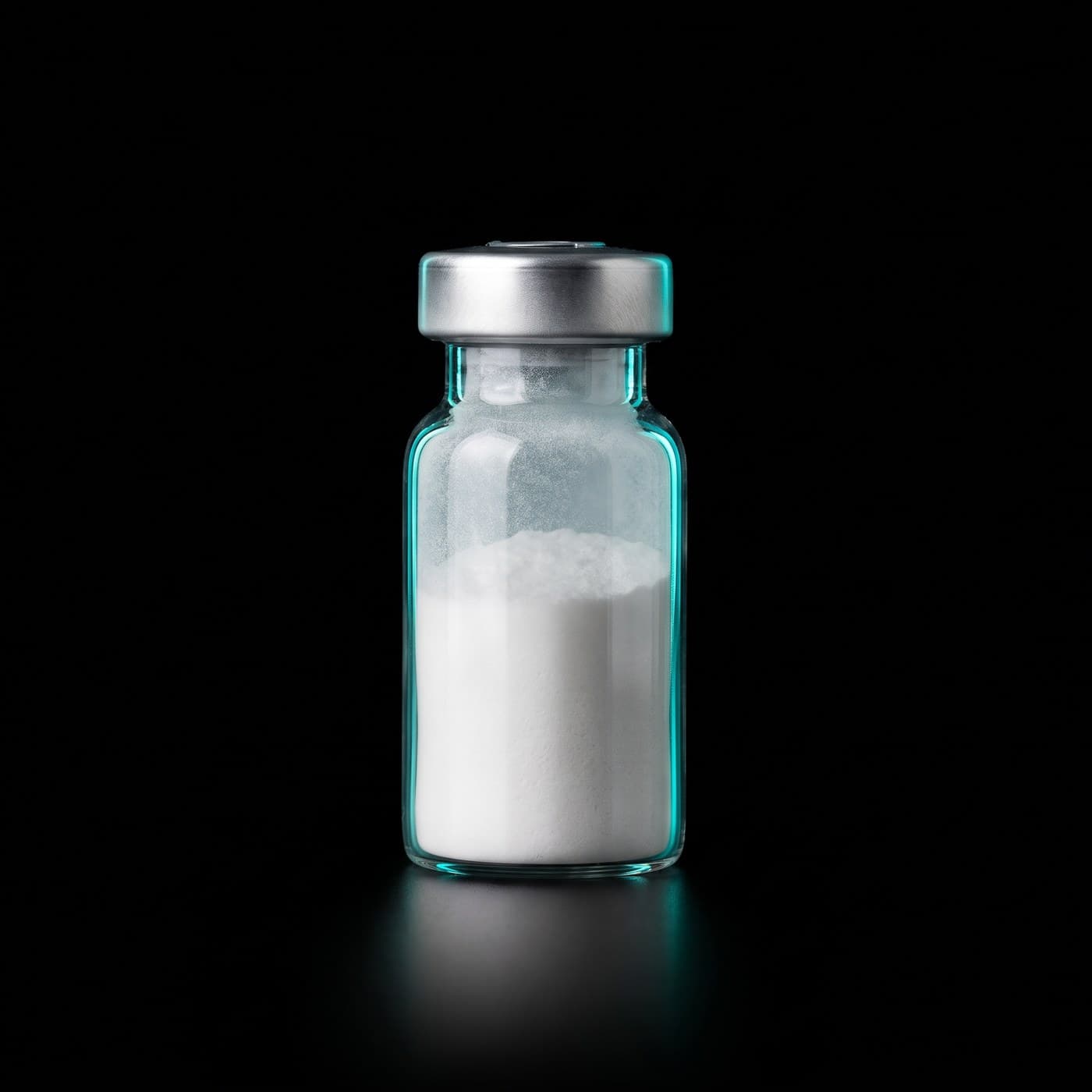
Ipamorelin
A pentapeptide described in 1998 as the first selective growth hormone secretagogue, acting at the ghrelin receptor GHS-R1a.
- Purity
- 99.2%
- Lot
- PU-5AA6
- CAS
- 170851-70-4
- MW
- 711.85 g/mol
- Format
- Lyophilized powder
- Third-party tested
- Discreet packaging
- Same-day shipping
- Encrypted checkout
For research use only. Not for human consumption.
Mechanism of Action
Ipamorelin was introduced in the European Journal of Endocrinology in 1998 as the first selective growth hormone secretagogue - selective in the sense that, unlike earlier secretagogues, it released growth hormone without a comparable rise in ACTH or cortisol in the models tested. It acts at GHS-R1a, the receptor for ghrelin, which is distinct from the GHRH receptor.
Because GHS-R1a and the GHRH receptor are separate, the pharmacology literature has examined secretagogues and GHRH analogues both individually and in combination. Receptor characterisation work has mapped the binding domain of GHS-R and profiled the wider secretagogue family.
Research Findings
Primary studies characterised the secretory profile and pharmacokinetics of the peptide across species, and a 2001 report in Growth Hormone and IGF Research examined bone parameters in a glucocorticoid-treated rat model.
The wider literature on GHS-R ligands includes structural and molecular-recognition studies of approved secretagogues, and recent orthopaedic and sports-medicine reviews that survey the class and its evidence gaps.
Storage & Reconstitution
Sealed lyophilized vials are stored in the dark. The peptide-formulation literature regards the dry solid as the stable state and the solution as the fragile one: refrigeration at 2-8 degrees C is standard for short holding periods, and minus 20 degrees C or colder for long-term storage. Vials are brought to room temperature before opening so that atmospheric moisture does not condense onto the cold solid.
For reconstitution, the diluent is added slowly down the inner wall of the vial rather than directly onto the cake, and the vial is swirled rather than shaken - agitation at an air-liquid interface is a well-documented driver of peptide aggregation. The solid should dissolve to a clear, particle-free solution; persistent cloudiness or visible particulate indicates the material should not be used.
Reconstituted solution is held at 2-8 degrees C and protected from light. Freeze-thaw cycling is the single most avoidable cause of loss, so where a solution must be frozen it is aliquoted first into single-use volumes. Working aliquots are labelled with the lot number so that any result can be traced back to the certificate of analysis for that lot.
- Physical form
- Lyophilized powder, sealed vial
- Sealed storage
- 2-8 C short term / -20 C long term
- Reconstituted
- 2-8 C, protected from light
- Diluent
- Bacteriostatic water, added down the vial wall
- Avoid
- Shaking, freeze-thaw cycling, direct light
Handling summary
References
Every entry below links to its PubMed record. Publication is not endorsement: several of these papers report limitations, negative findings or adverse events, and they are listed for that reason.
- [1]Ipamorelin, the first selective growth hormone secretagogue(opens PubMed in a new tab)
Eur J Endocrinol · 1998 · PMID 9849822
- [2]Growth hormone secretagogue receptor family members and ligands(opens PubMed in a new tab)
Endocrine · 2001 · PMID 11322507
- [3]Binding Domain Characterization of Growth Hormone Secretagogue Receptor(opens PubMed in a new tab)
J Transl Int Med · 2022 · PMID 35959447
- [4]The growth hormone secretagogue receptor (Ghs-R)(opens PubMed in a new tab)
Curr Pharm Des · 2012 · PMID 22632856
- [5]The growth hormone secretagogue receptor(opens PubMed in a new tab)
Vitam Horm · 2008 · PMID 17983853
- [6]Molecular recognition of two approved drugs Macimorelin and Anamorelin by the growth hormone secretagogue receptor(opens PubMed in a new tab)
Acta Pharmacol Sin · 2025 · PMID 40542284