
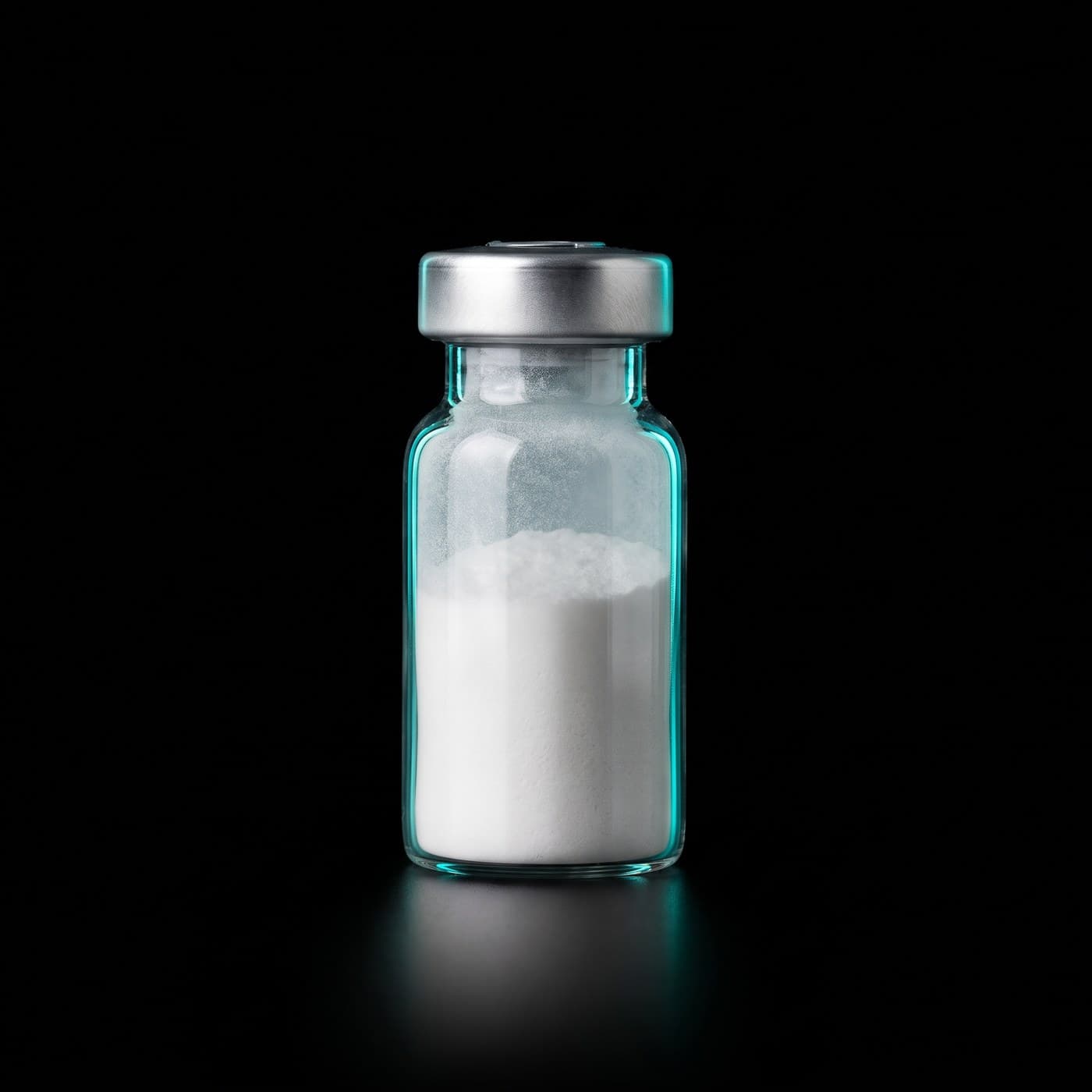
Kisspeptin
The peptide product of the KISS1 gene, established as an upstream regulator of gonadotropin-releasing hormone neurons.
- Purity
- 99.2%
- Lot
- PU-EA57
- Format
- Lyophilized powder
- Third-party tested
- Discreet packaging
- Same-day shipping
- Encrypted checkout
For research use only. Not for human consumption.
Mechanism of Action
Kisspeptin is the ligand of the KISS1 receptor (formerly GPR54) and sits directly upstream of gonadotropin-releasing hormone neurons in the hypothalamus. Loss-of-function mutations in this system produce hypogonadotropic hypogonadism, which is what established the pathway as obligatory rather than modulatory.
Published work has characterised kisspeptin-GnRH interactions and pulse generation, and a 2024 study in the Journal of Clinical Investigation reported that kisspeptin signalling in astrocytes also modulates the reproductive axis. A 2020 review in Nature Reviews Endocrinology examined the link between energy balance and reproduction through this system.
Research Findings
The indexed literature covers hypothalamic-pituitary-gonadal axis control, functional hypothalamic amenorrhoea, neuronal heterogeneity within kisspeptin populations, and comparative work in non-mammalian vertebrates.
Reviews in Human Reproduction Update and Frontiers in Endocrinology collect the human physiology. Antagonist pharmacology has been developed alongside the agonist literature and is included below.
Storage & Reconstitution
Sealed lyophilized vials are stored in the dark. The peptide-formulation literature regards the dry solid as the stable state and the solution as the fragile one: refrigeration at 2-8 degrees C is standard for short holding periods, and minus 20 degrees C or colder for long-term storage. Vials are brought to room temperature before opening so that atmospheric moisture does not condense onto the cold solid.
For reconstitution, the diluent is added slowly down the inner wall of the vial rather than directly onto the cake, and the vial is swirled rather than shaken - agitation at an air-liquid interface is a well-documented driver of peptide aggregation. The solid should dissolve to a clear, particle-free solution; persistent cloudiness or visible particulate indicates the material should not be used.
Reconstituted solution is held at 2-8 degrees C and protected from light. Freeze-thaw cycling is the single most avoidable cause of loss, so where a solution must be frozen it is aliquoted first into single-use volumes. Working aliquots are labelled with the lot number so that any result can be traced back to the certificate of analysis for that lot.
- Physical form
- Lyophilized powder, sealed vial
- Sealed storage
- 2-8 C short term / -20 C long term
- Reconstituted
- 2-8 C, protected from light
- Diluent
- Bacteriostatic water, added down the vial wall
- Avoid
- Shaking, freeze-thaw cycling, direct light
Handling summary
References
Every entry below links to its PubMed record. Publication is not endorsement: several of these papers report limitations, negative findings or adverse events, and they are listed for that reason.
- [1]The Role of Kisspeptin in the Control of the Hypothalamic-Pituitary-Gonadal Axis and Reproduction(opens PubMed in a new tab)
Front Endocrinol (Lausanne) · 2022 · PMID 35837314
- [2]Stress, kisspeptin, and functional hypothalamic amenorrhea(opens PubMed in a new tab)
Curr Opin Pharmacol · 2022 · PMID 36103784
- [3]Kisspeptin signaling in astrocytes modulates the reproductive axis(opens PubMed in a new tab)
J Clin Invest · 2024 · PMID 38861336
- [4]Metabolic regulation of kisspeptin - the link between energy balance and reproduction(opens PubMed in a new tab)
Nat Rev Endocrinol · 2020 · PMID 32427949
- [5]Kisspeptin antagonists(opens PubMed in a new tab)
Adv Exp Med Biol · 2013 · PMID 23550006
- [6]Kisspeptin and GnRH interactions in the reproductive brain of teleosts(opens PubMed in a new tab)
Gen Comp Endocrinol · 2020 · PMID 32710898