
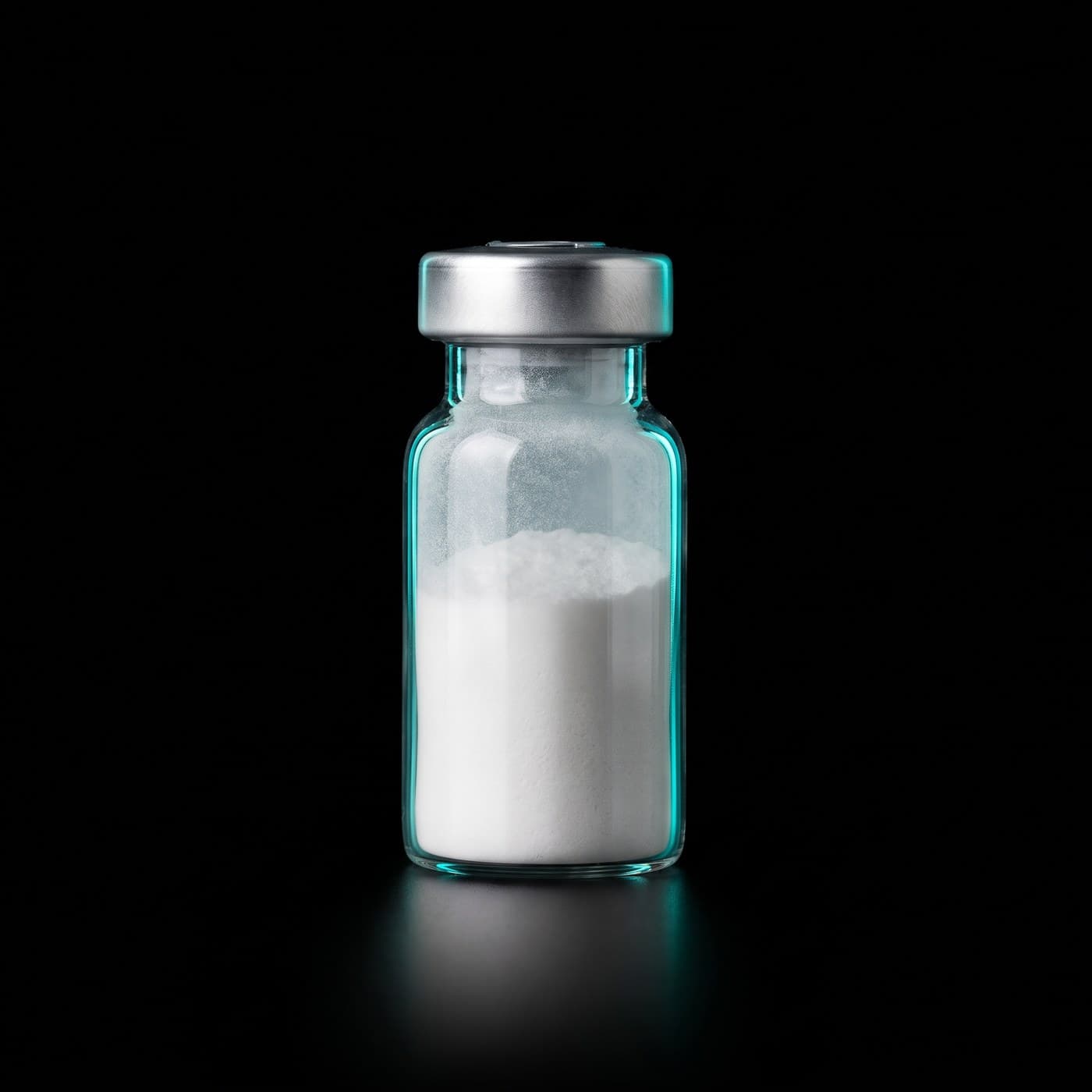
KPV
The C-terminal tripeptide of alpha-melanocyte-stimulating hormone, studied for anti-inflammatory activity that appears to be separable from melanocortin receptor signalling.
- Purity
- 99.2%
- Lot
- PU-8F5D
- Format
- Lyophilized powder
- Third-party tested
- Discreet packaging
- Same-day shipping
- Encrypted checkout
For research use only. Not for human consumption.
Mechanism of Action
KPV is the C-terminal tripeptide (lysine-proline-valine) of alpha-melanocyte-stimulating hormone. Published dissection studies have reported that the anti-inflammatory activity of the parent hormone is retained in this fragment while the pigmentary activity is not, which is the basis for studying the fragment separately.
Uptake work in intestinal epithelium has described transport by the oligopeptide transporter PepT1, with downstream effects on NF-kB-associated inflammatory signalling reported in cell and rodent colitis models. Whether melanocortin receptors are required for the fragment's activity remains contested in the literature.
Research Findings
Studies published in Gastroenterology and Inflammatory Bowel Diseases examined PepT1-mediated uptake and inflammation endpoints in murine colitis models. Related work in the Journal of Pharmacology and Experimental Therapeutics dissected the contribution of the core and C-terminal regions of the parent hormone.
More recent reports have examined nanoparticle and self-assembling delivery formats, keratinocyte models and vascular calcification. The alpha-MSH review literature places the fragment within a broader class of anti-inflammatory melanocortin-derived peptides.
Storage & Reconstitution
Sealed lyophilized vials are stored in the dark. The peptide-formulation literature regards the dry solid as the stable state and the solution as the fragile one: refrigeration at 2-8 degrees C is standard for short holding periods, and minus 20 degrees C or colder for long-term storage. Vials are brought to room temperature before opening so that atmospheric moisture does not condense onto the cold solid. Short unmodified tripeptides such as this are handled as standard lyophilized solids; the primary handling risk is peptidase activity in a non-sterile reconstituted solution.
For reconstitution, the diluent is added slowly down the inner wall of the vial rather than directly onto the cake, and the vial is swirled rather than shaken - agitation at an air-liquid interface is a well-documented driver of peptide aggregation. The solid should dissolve to a clear, particle-free solution; persistent cloudiness or visible particulate indicates the material should not be used.
Reconstituted solution is held at 2-8 degrees C and protected from light. Freeze-thaw cycling is the single most avoidable cause of loss, so where a solution must be frozen it is aliquoted first into single-use volumes. Working aliquots are labelled with the lot number so that any result can be traced back to the certificate of analysis for that lot.
- Physical form
- Lyophilized powder, sealed vial
- Sealed storage
- 2-8 C short term / -20 C long term
- Reconstituted
- 2-8 C, protected from light
- Diluent
- Bacteriostatic water, added down the vial wall
- Avoid
- Shaking, freeze-thaw cycling, direct light
Handling summary
References
Every entry below links to its PubMed record. Publication is not endorsement: several of these papers report limitations, negative findings or adverse events, and they are listed for that reason.
- [1]alpha-Melanocyte-stimulating hormone, MSH 11-13 KPV and adrenocorticotropic hormone signalling in human keratinocyte cells(opens PubMed in a new tab)
J Invest Dermatol · 2004 · PMID 15102092
- [2]The neuroimmunomodulatory peptide alpha-MSH(opens PubMed in a new tab)
Ann N Y Acad Sci · 2000 · PMID 11268347
- [3]KPV and RAPA Self-Assembled into Carrier-Free Nanodrugs for Vascular Calcification Therapy(opens PubMed in a new tab)
Adv Healthc Mater · 2024 · PMID 39252648
- [4]The neuropeptide alpha-MSH in host defense(opens PubMed in a new tab)
Ann N Y Acad Sci · 2000 · PMID 11268348
- [5]PepT1-mediated tripeptide KPV uptake reduces intestinal inflammation(opens PubMed in a new tab)
Gastroenterology · 2008 · PMID 18061177
- [6]Dissection of the anti-inflammatory effect of the core and C-terminal (KPV) alpha-melanocyte-stimulating hormone peptides(opens PubMed in a new tab)
J Pharmacol Exp Ther · 2003 · PMID 12750433