
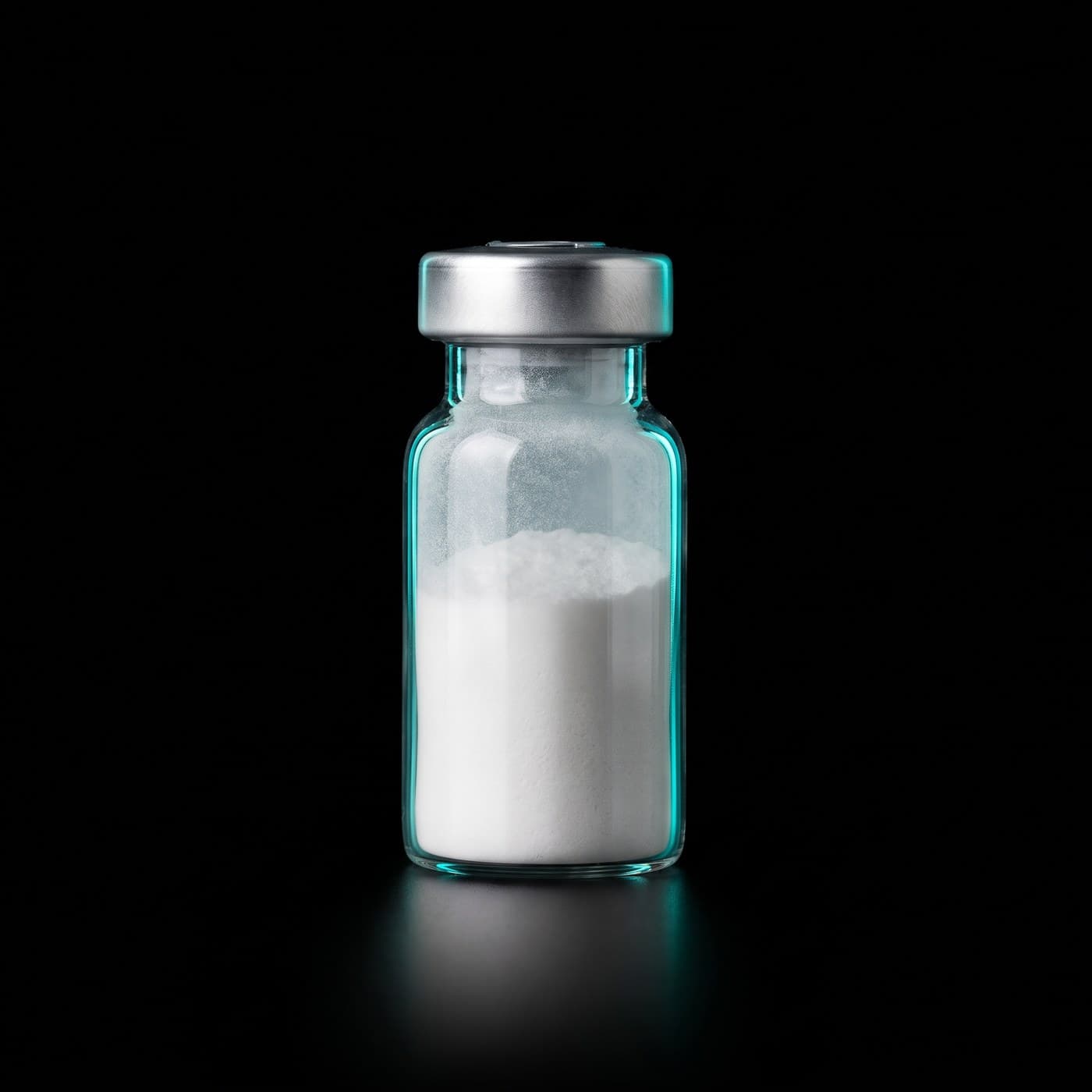
LL-37
The 37-residue C-terminal peptide of human cathelicidin hCAP-18, the only cathelicidin in the human genome.
- Purity
- 99.2%
- Lot
- PU-3FE6
- Format
- Lyophilized powder
- Third-party tested
- Discreet packaging
- Same-day shipping
- Encrypted checkout
For research use only. Not for human consumption.
Mechanism of Action
LL-37 is released by proteolytic processing from hCAP-18, the single human cathelicidin. It is an amphipathic cationic alpha-helix, and its direct antimicrobial activity has been attributed to membrane permeabilisation - a 2016 Biochimica et Biophysica Acta review describes it as a pore-forming peptide and simultaneously as a host-cell modulator.
The immunomodulatory arm of its activity is separable from the antimicrobial arm and has been studied in its own right, including chemotactic activity, nucleic-acid complexation and effects on epithelial barrier function. A 2023 Peptides paper examined which structural domain drives the immunomodulatory response.
Research Findings
Published work covers antibacterial, antibiofilm and antifungal activity, reviewed separately in the World Journal of Microbiology and Biotechnology, along with roles in pulmonary defence and intestinal barrier preservation in rat models.
The peptide also appears in the cancer literature and in a 2026 review examining its role in wound healing alongside ceragenins. Reviewers consistently note that activity is strongly dependent on ionic strength and serum, which complicates comparison between studies.
Storage & Reconstitution
Sealed lyophilized vials are stored in the dark. The peptide-formulation literature regards the dry solid as the stable state and the solution as the fragile one: refrigeration at 2-8 degrees C is standard for short holding periods, and minus 20 degrees C or colder for long-term storage. Vials are brought to room temperature before opening so that atmospheric moisture does not condense onto the cold solid. Cationic amphipathic peptides adsorb to glass and to some plastics; the handling literature recommends low-binding polypropylene for dilute solutions.
For reconstitution, the diluent is added slowly down the inner wall of the vial rather than directly onto the cake, and the vial is swirled rather than shaken - agitation at an air-liquid interface is a well-documented driver of peptide aggregation. The solid should dissolve to a clear, particle-free solution; persistent cloudiness or visible particulate indicates the material should not be used.
Reconstituted solution is held at 2-8 degrees C and protected from light. Freeze-thaw cycling is the single most avoidable cause of loss, so where a solution must be frozen it is aliquoted first into single-use volumes. Working aliquots are labelled with the lot number so that any result can be traced back to the certificate of analysis for that lot.
- Physical form
- Lyophilized powder, sealed vial
- Sealed storage
- 2-8 C short term / -20 C long term
- Reconstituted
- 2-8 C, protected from light
- Diluent
- Bacteriostatic water, added down the vial wall
- Avoid
- Shaking, freeze-thaw cycling, direct light
Handling summary
References
Every entry below links to its PubMed record. Publication is not endorsement: several of these papers report limitations, negative findings or adverse events, and they are listed for that reason.
- [1]Antifungal properties of cathelicidin LL-37: current knowledge and future research directions(opens PubMed in a new tab)
World J Microbiol Biotechnol · 2023 · PMID 38057654
- [2]Cathelicidin LL-37 in periodontitis: current research advances and future prospects - A review(opens PubMed in a new tab)
Int Immunopharmacol · 2025 · PMID 39954662
- [3]Roles and Mechanisms of Human Cathelicidin LL-37 in Cancer(opens PubMed in a new tab)
Cell Physiol Biochem · 2018 · PMID 29843147
- [4]Antimicrobial Peptides of the Cathelicidin Family: Focus on LL-37 and Its Modifications(opens PubMed in a new tab)
Int J Mol Sci · 2025 · PMID 40869425
- [5]Between good and evil: Complexation of the human cathelicidin LL-37 with nucleic acids(opens PubMed in a new tab)
Biophys J · 2024 · PMID 37919905
- [6]The human cathelicidin LL-37--A pore-forming antibacterial peptide and host-cell modulator(opens PubMed in a new tab)
Biochim Biophys Acta · 2016 · PMID 26556394