
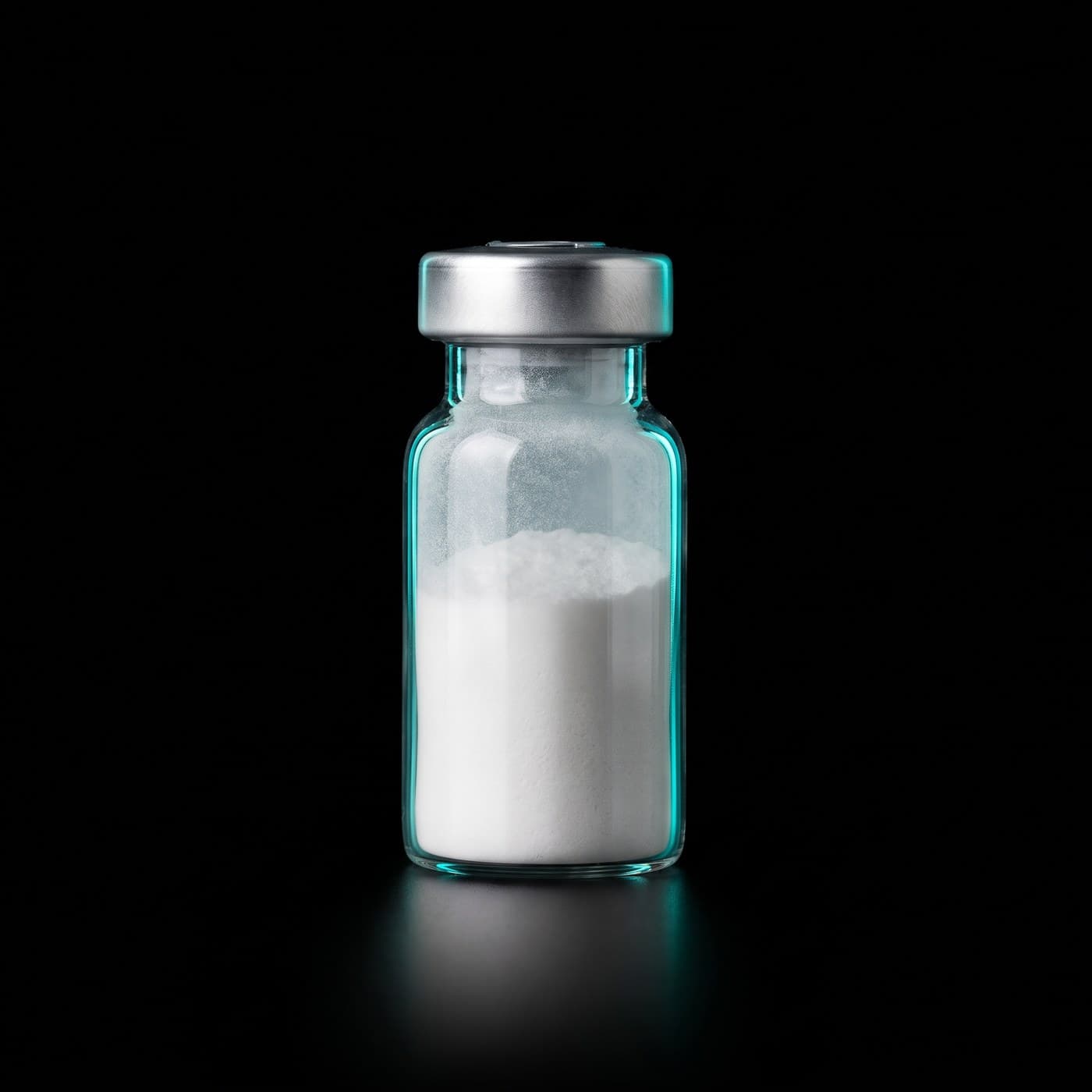
N-Acetyl Selank Amidate
Selank modified with an N-terminal acetyl group and a C-terminal amide, intended to slow exopeptidase degradation of the parent sequence.
- Purity
- 99.2%
- Lot
- PU-8070
- Format
- Lyophilized powder
- Third-party tested
- Discreet packaging
- Same-day shipping
- Encrypted checkout
For research use only. Not for human consumption.
Mechanism of Action
This preparation is the Selank sequence carrying an N-terminal acetyl group and a C-terminal amide. Both modifications block exopeptidase recognition - acetylation removes the free alpha-amino terminus, amidation the free carboxy terminus - and are used across peptide chemistry for that purpose.
The underlying pharmacology is that of the parent tuftsin analogue: reported modulation of inflammation-related gene expression, hippocampal transcriptome changes and GABAergic signalling gene expression in rodent studies.
Research Findings
No indexed study examines this exact modified sequence. The references below are the Selank and tuftsin literature, which covers the parent peptide's behavioural and transcriptional characterisation in rodents and a small clinical literature in anxiety disorders.
Terminal modification alters pharmacokinetics and may alter potency; results reported for the parent peptide are a starting hypothesis for work with the modified form, not a substitute for characterising it.
Storage & Reconstitution
Sealed lyophilized vials are stored in the dark. The peptide-formulation literature regards the dry solid as the stable state and the solution as the fragile one: refrigeration at 2-8 degrees C is standard for short holding periods, and minus 20 degrees C or colder for long-term storage. Vials are brought to room temperature before opening so that atmospheric moisture does not condense onto the cold solid. Terminal acetylation and amidation increase protease resistance; the modified peptide is nonetheless handled under the same conditions as the parent.
For reconstitution, the diluent is added slowly down the inner wall of the vial rather than directly onto the cake, and the vial is swirled rather than shaken - agitation at an air-liquid interface is a well-documented driver of peptide aggregation. The solid should dissolve to a clear, particle-free solution; persistent cloudiness or visible particulate indicates the material should not be used.
Reconstituted solution is held at 2-8 degrees C and protected from light. Freeze-thaw cycling is the single most avoidable cause of loss, so where a solution must be frozen it is aliquoted first into single-use volumes. Working aliquots are labelled with the lot number so that any result can be traced back to the certificate of analysis for that lot.
- Physical form
- Lyophilized powder, sealed vial
- Sealed storage
- 2-8 C short term / -20 C long term
- Reconstituted
- 2-8 C, protected from light
- Diluent
- Bacteriostatic water, added down the vial wall
- Avoid
- Shaking, freeze-thaw cycling, direct light
Handling summary
References
Every entry below links to its PubMed record. Publication is not endorsement: several of these papers report limitations, negative findings or adverse events, and they are listed for that reason.
- [1]Functional Connectomic Approach to Studying Selank and Semax Effects(opens PubMed in a new tab)
Dokl Biol Sci · 2020 · PMID 32342318
- [2]Selank, a Peptide Analog of Tuftsin, Attenuates Aversive Signs of Morphine Withdrawal in Rats(opens PubMed in a new tab)
Bull Exp Biol Med · 2022 · PMID 36322304
- [3]Tuftsin - Properties and Analogs(opens PubMed in a new tab)
Curr Med Chem · 2017 · PMID 28745220
- [4]The temporary dynamics of inflammation-related genes expression under tuftsin analog Selank action(opens PubMed in a new tab)
Mol Immunol · 2014 · PMID 24291245
- [5]Expression of inflammation-related genes in mouse spleen under tuftsin analog Selank(opens PubMed in a new tab)
Regul Pept · 2011 · PMID 21609736
- [6]