
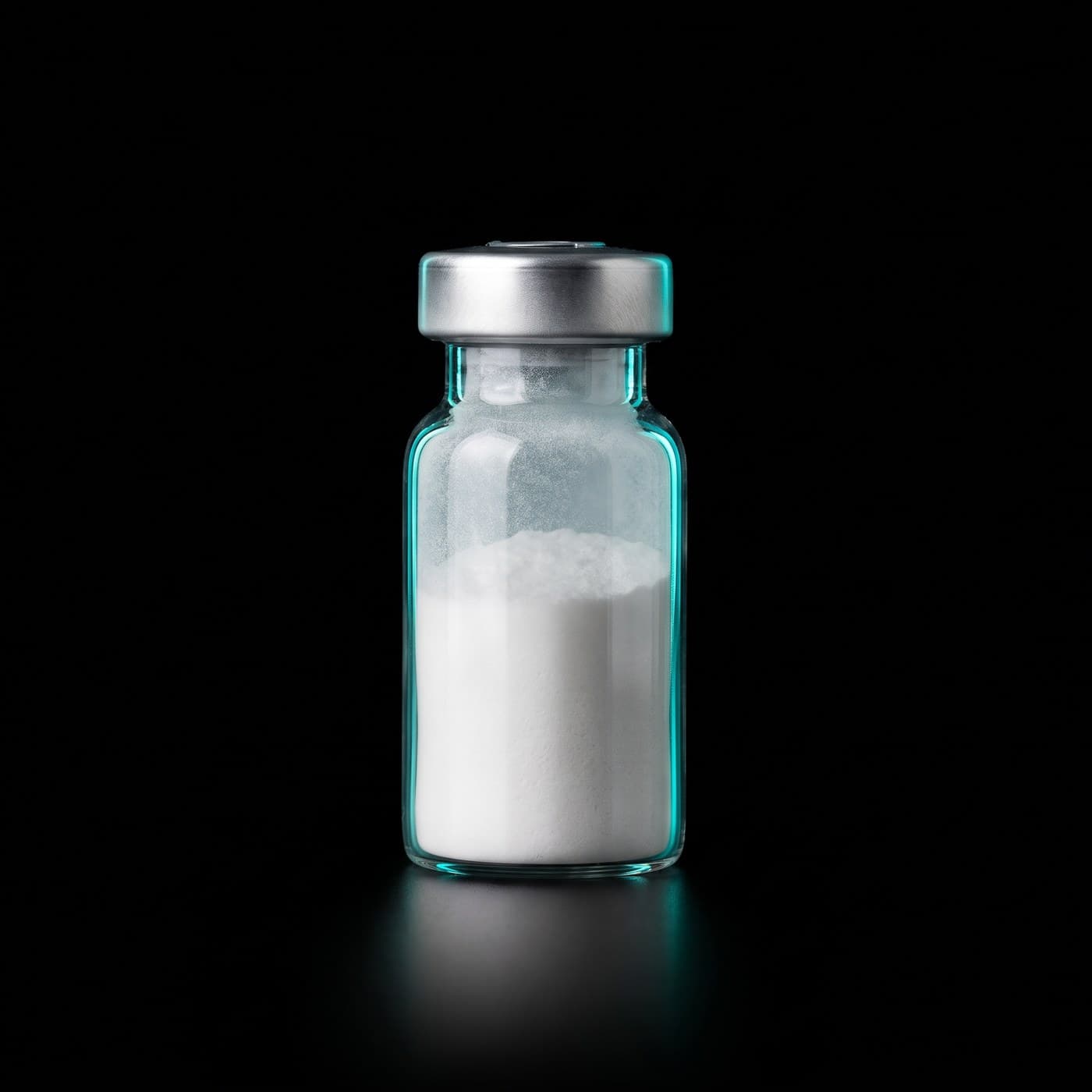
N-Acetyl Semax Amidate
Semax modified with an N-terminal acetyl group and a C-terminal amide, a pair of modifications studied specifically for their effect on peptide half-life.
- Purity
- 99.2%
- Lot
- PU-D14C
- Format
- Lyophilized powder
- Third-party tested
- Discreet packaging
- Same-day shipping
- Encrypted checkout
For research use only. Not for human consumption.
Mechanism of Action
This preparation is Semax carrying two terminal modifications: an N-terminal acetyl group and a C-terminal amide. Both are standard medicinal-chemistry strategies for blocking exopeptidase attack - acetylation removes the free alpha-amino group that aminopeptidases require, and amidation removes the free carboxylate recognised by carboxypeptidases.
The rationale is grounded in the parent literature: 1991 and 1993 studies measured how quickly rat blood and serum enzymes degrade unmodified Semax and ACTH(4-10). A 2016 paper in the Journal of Inorganic Biochemistry examined how N-terminal acetylation of Semax changes its copper(II) coordination, which is a direct demonstration that the modification alters the molecule's chemistry and not only its half-life.
Research Findings
No published study indexes this exact modified sequence under this name. The references below are the Semax literature, which describes the parent peptide's reported effects on BDNF and TrkB expression, monoaminergic signalling and ischaemia-related gene expression.
Because acetylation and amidation change both stability and coordination chemistry, findings for the parent peptide should not be assumed to transfer quantitatively. That gap is the honest position of the current record.
Storage & Reconstitution
Sealed lyophilized vials are stored in the dark. The peptide-formulation literature regards the dry solid as the stable state and the solution as the fragile one: refrigeration at 2-8 degrees C is standard for short holding periods, and minus 20 degrees C or colder for long-term storage. Vials are brought to room temperature before opening so that atmospheric moisture does not condense onto the cold solid. Terminal acetylation and amidation increase protease resistance; the modified peptide is nonetheless handled under the same conditions as the parent.
For reconstitution, the diluent is added slowly down the inner wall of the vial rather than directly onto the cake, and the vial is swirled rather than shaken - agitation at an air-liquid interface is a well-documented driver of peptide aggregation. The solid should dissolve to a clear, particle-free solution; persistent cloudiness or visible particulate indicates the material should not be used.
Reconstituted solution is held at 2-8 degrees C and protected from light. Freeze-thaw cycling is the single most avoidable cause of loss, so where a solution must be frozen it is aliquoted first into single-use volumes. Working aliquots are labelled with the lot number so that any result can be traced back to the certificate of analysis for that lot.
- Physical form
- Lyophilized powder, sealed vial
- Sealed storage
- 2-8 C short term / -20 C long term
- Reconstituted
- 2-8 C, protected from light
- Diluent
- Bacteriostatic water, added down the vial wall
- Avoid
- Shaking, freeze-thaw cycling, direct light
Handling summary
References
Every entry below links to its PubMed record. Publication is not endorsement: several of these papers report limitations, negative findings or adverse events, and they are listed for that reason.
- [1]Functional Connectomic Approach to Studying Selank and Semax Effects(opens PubMed in a new tab)
Dokl Biol Sci · 2020 · PMID 32342318
- [2]
- [3]
- [4]
- [5]
- [6]