
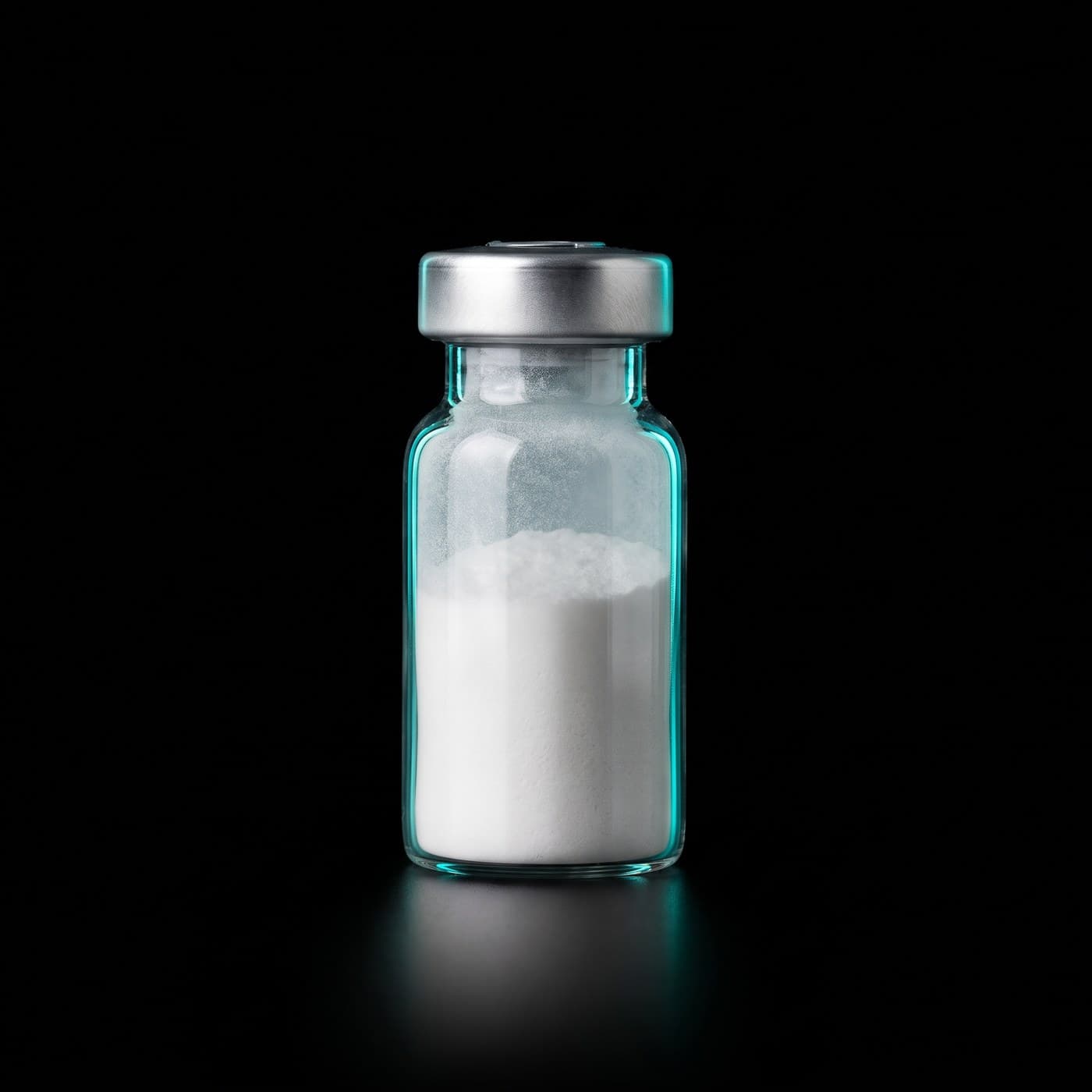
NAD+
Nicotinamide adenine dinucleotide, the central redox cofactor of cellular metabolism and the obligatory substrate of sirtuins and PARPs.
- Purity
- 99.2%
- Lot
- PU-5D46
- CAS
- 53-84-9
- MW
- 663.43 g/mol
- Format
- Lyophilized powder
- Third-party tested
- Discreet packaging
- Same-day shipping
- Encrypted checkout
For research use only. Not for human consumption.
Mechanism of Action
NAD+ is not a peptide. It is the central pyridine-nucleotide cofactor of intermediary metabolism, cycling between oxidised and reduced forms in hundreds of dehydrogenase reactions, and it is consumed - not merely cycled - by sirtuins, PARPs and CD38.
That consumption is why NAD+ pool size is regarded as a regulated variable rather than a constant. Reviews in Nature Reviews Molecular Cell Biology and Nature Metabolism describe NAD+ homeostasis as the balance between salvage-pathway synthesis and consumption by these enzymes, and connect pool size to sirtuin-dependent signalling.
Research Findings
The indexed literature is very large and predominantly mechanistic: NAD+ metabolism in ageing biology, senescence regulation, cardiac energy metabolism, and the kynurenine pathway. A 2023 Endocrine Reviews article is explicit in its title that substantial uncertainty remains.
Work on precursors such as nicotinamide mononucleotide and nicotinamide riboside is reviewed in Cell Metabolism and EMBO Molecular Medicine, and is methodologically relevant because precursor and direct-cofactor approaches raise different bioavailability questions.
Storage & Reconstitution
Sealed lyophilized vials are stored in the dark. The peptide-formulation literature regards the dry solid as the stable state and the solution as the fragile one: refrigeration at 2-8 degrees C is standard for short holding periods, and minus 20 degrees C or colder for long-term storage. Vials are brought to room temperature before opening so that atmospheric moisture does not condense onto the cold solid. NAD+ is hygroscopic and hydrolyses in aqueous solution, particularly at neutral to alkaline pH; the practical consequence is that solutions are prepared fresh rather than stored.
For reconstitution, the diluent is added slowly down the inner wall of the vial rather than directly onto the cake, and the vial is swirled rather than shaken - agitation at an air-liquid interface is a well-documented driver of peptide aggregation. The solid should dissolve to a clear, particle-free solution; persistent cloudiness or visible particulate indicates the material should not be used.
Reconstituted solution is held at 2-8 degrees C and protected from light. Freeze-thaw cycling is the single most avoidable cause of loss, so where a solution must be frozen it is aliquoted first into single-use volumes. Working aliquots are labelled with the lot number so that any result can be traced back to the certificate of analysis for that lot.
- Physical form
- Lyophilized powder, sealed vial
- Sealed storage
- 2-8 C short term / -20 C long term
- Reconstituted
- 2-8 C, protected from light
- Diluent
- Bacteriostatic water, added down the vial wall
- Avoid
- Shaking, freeze-thaw cycling, direct light
Handling summary
References
Every entry below links to its PubMed record. Publication is not endorsement: several of these papers report limitations, negative findings or adverse events, and they are listed for that reason.
- [1]NAD(+) metabolism and its roles in cellular processes during ageing(opens PubMed in a new tab)
Nat Rev Mol Cell Biol · 2021 · PMID 33353981
- [2]NAD+ and sirtuins in aging and disease(opens PubMed in a new tab)
Trends Cell Biol · 2014 · PMID 24786309
- [3]Nicotinamide Adenine Dinucleotide in Aging Biology: Potential Applications and Many Unknowns(opens PubMed in a new tab)
Endocr Rev · 2023 · PMID 37364580
- [4]NAD⁺ in aging, metabolism, and neurodegeneration(opens PubMed in a new tab)
Science · 2015 · PMID 26785480
- [5]NAD metabolism: Role in senescence regulation and aging(opens PubMed in a new tab)
Aging Cell · 2024 · PMID 37424179
- [6]NAD(+) homeostasis in health and disease(opens PubMed in a new tab)
Nat Metab · 2020 · PMID 32694684