
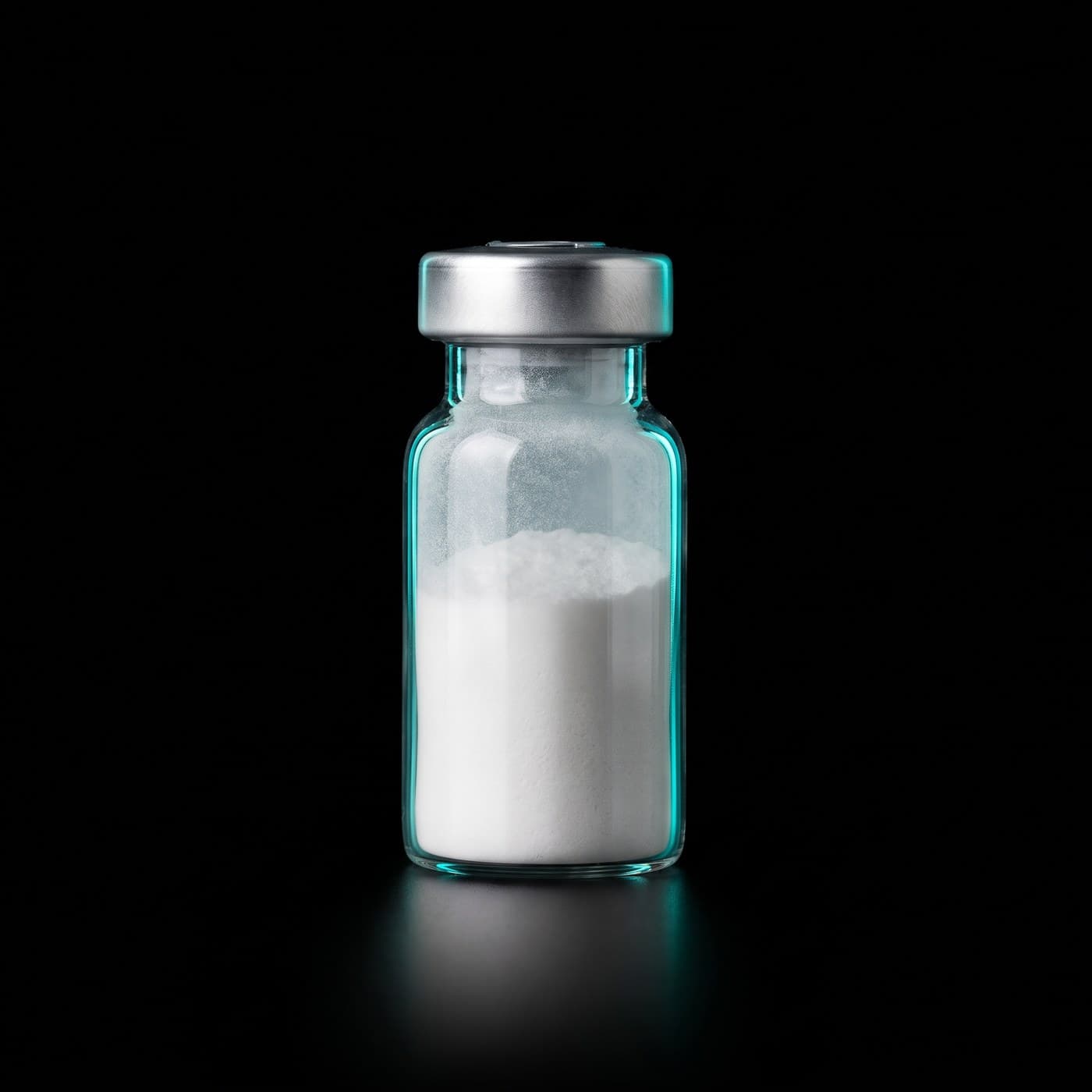
Pinealon
A synthetic tripeptide (Glu-Asp-Arg) from the short regulatory peptide programme, studied for effects on gene expression and cell viability under oxidative stress.
- Purity
- 99.2%
- Lot
- PU-6410
- Format
- Lyophilized powder
- Third-party tested
- Discreet packaging
- Same-day shipping
- Encrypted checkout
For research use only. Not for human consumption.
Mechanism of Action
Pinealon is the tripeptide Glu-Asp-Arg, part of the same short regulatory peptide research programme that produced Epitalon. The proposed mechanism in this literature is direct peptide-DNA interaction; a 2019 study in the Journal of Physical Chemistry B examined the role of mono- and divalent ions in the interaction between the EDR peptide and DNA.
A 2020 paper in Molecules set out a proposed mechanism for gene-expression and protein-synthesis regulation. Reported cellular effects have centred on free-radical levels and proliferative activity rather than on a defined receptor.
Research Findings
A 2011 Rejuvenation Research study reported cell-viability and free-radical endpoints in culture. Rodent work has examined antihypoxic properties of short peptides and protection of offspring in a prenatal hyperhomocysteinaemia model.
A 2024 study in the International Journal of Molecular Sciences examined short peptides in fibroblast-derived induced neurons. The literature is concentrated in a small number of groups and in gerontology journals with limited external replication.
Storage & Reconstitution
Sealed lyophilized vials are stored in the dark. The peptide-formulation literature regards the dry solid as the stable state and the solution as the fragile one: refrigeration at 2-8 degrees C is standard for short holding periods, and minus 20 degrees C or colder for long-term storage. Vials are brought to room temperature before opening so that atmospheric moisture does not condense onto the cold solid.
For reconstitution, the diluent is added slowly down the inner wall of the vial rather than directly onto the cake, and the vial is swirled rather than shaken - agitation at an air-liquid interface is a well-documented driver of peptide aggregation. The solid should dissolve to a clear, particle-free solution; persistent cloudiness or visible particulate indicates the material should not be used.
Reconstituted solution is held at 2-8 degrees C and protected from light. Freeze-thaw cycling is the single most avoidable cause of loss, so where a solution must be frozen it is aliquoted first into single-use volumes. Working aliquots are labelled with the lot number so that any result can be traced back to the certificate of analysis for that lot.
- Physical form
- Lyophilized powder, sealed vial
- Sealed storage
- 2-8 C short term / -20 C long term
- Reconstituted
- 2-8 C, protected from light
- Diluent
- Bacteriostatic water, added down the vial wall
- Avoid
- Shaking, freeze-thaw cycling, direct light
Handling summary
References
Every entry below links to its PubMed record. Publication is not endorsement: several of these papers report limitations, negative findings or adverse events, and they are listed for that reason.
- [1]
- [2]Pinealon increases cell viability by suppression of free radical levels and activating proliferative processes(opens PubMed in a new tab)
Rejuvenation Res · 2011 · PMID 21978084
- [3]Pinealon protects the rat offspring from prenatal hyperhomocysteinemia(opens PubMed in a new tab)
Int J Clin Exp Med · 2012 · PMID 22567179
- [4]Short Peptides Protect Fibroblast-Derived Induced Neurons from Age-Related Changes(opens PubMed in a new tab)
Int J Mol Sci · 2024 · PMID 39518916
- [5]Overview of Epitalon-Highly Bioactive Pineal Tetrapeptide with Promising Properties(opens PubMed in a new tab)
Int J Mol Sci · 2025 · PMID 40141333
- [6]