
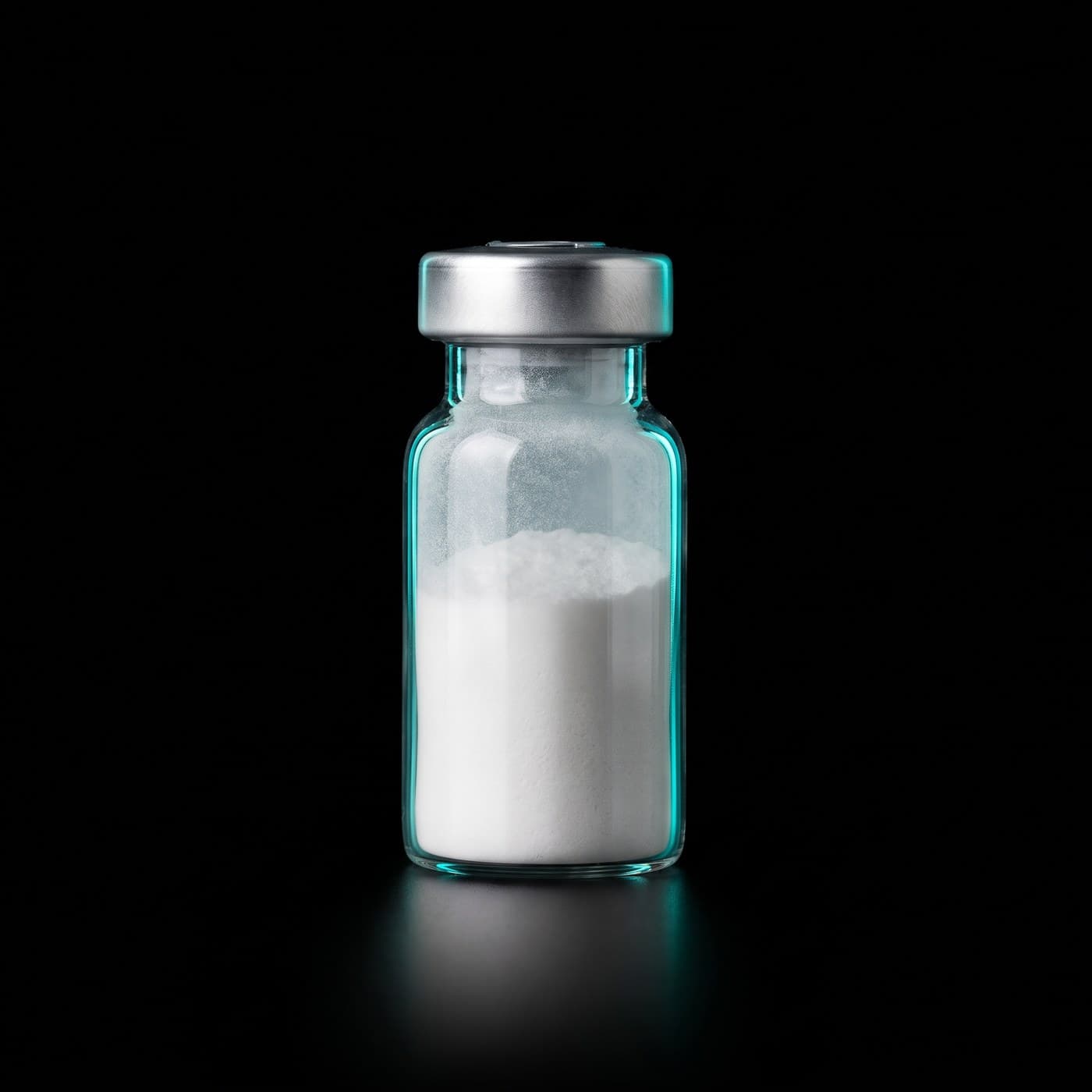
Retatrutide
A single-molecule agonist at three incretin and glucagon-family receptors, studied in phase 2 clinical programmes.
- Purity
- 99.2%
- Lot
- PU-59DC
- CAS
- 2381089-83-2
- MW
- 4731.30 g/mol
- Format
- Lyophilized powder
- Third-party tested
- Discreet packaging
- Same-day shipping
- Encrypted checkout
For research use only. Not for human consumption.
Mechanism of Action
Retatrutide is a single peptide engineered to act at three receptors: the GIP receptor, the GLP-1 receptor and the glucagon receptor. The pharmacological question in this class is the balance of potency across the three, since glucagon receptor agonism has metabolic consequences that oppose some of the incretin effects.
The comparative pharmacology of dual and triple agonists has been reviewed in Alimentary Pharmacology and Therapeutics, and the underlying incretin physiology in Diabetologia. Receptor-level work on the related dual agonist tirzepatide characterised signalling bias directly, which is the analytical framework applied to this class.
Research Findings
A 2023 Lancet study reported a randomised phase 2 trial in people with type 2 diabetes. A 2024 Nature Medicine study examined the compound in metabolic dysfunction-associated steatotic liver disease.
Class-level reviews cover pharmacokinetics and drug-drug interaction potential across approved and investigational agents in this family. The molecule remains investigational.
Storage & Reconstitution
Sealed lyophilized vials are stored in the dark. The peptide-formulation literature regards the dry solid as the stable state and the solution as the fragile one: refrigeration at 2-8 degrees C is standard for short holding periods, and minus 20 degrees C or colder for long-term storage. Vials are brought to room temperature before opening so that atmospheric moisture does not condense onto the cold solid.
For reconstitution, the diluent is added slowly down the inner wall of the vial rather than directly onto the cake, and the vial is swirled rather than shaken - agitation at an air-liquid interface is a well-documented driver of peptide aggregation. The solid should dissolve to a clear, particle-free solution; persistent cloudiness or visible particulate indicates the material should not be used.
Reconstituted solution is held at 2-8 degrees C and protected from light. Freeze-thaw cycling is the single most avoidable cause of loss, so where a solution must be frozen it is aliquoted first into single-use volumes. Working aliquots are labelled with the lot number so that any result can be traced back to the certificate of analysis for that lot.
- Physical form
- Lyophilized powder, sealed vial
- Sealed storage
- 2-8 C short term / -20 C long term
- Reconstituted
- 2-8 C, protected from light
- Diluent
- Bacteriostatic water, added down the vial wall
- Avoid
- Shaking, freeze-thaw cycling, direct light
Handling summary
References
Every entry below links to its PubMed record. Publication is not endorsement: several of these papers report limitations, negative findings or adverse events, and they are listed for that reason.
- [1]
- [2]
- [3]Tirzepatide is an imbalanced and biased dual GIP and GLP-1 receptor agonist(opens PubMed in a new tab)
JCI Insight · 2020 · PMID 32730231
- [4]
- [5]
- [6]Incretin hormones and type 2 diabetes(opens PubMed in a new tab)
Diabetologia · 2023 · PMID 37430117