
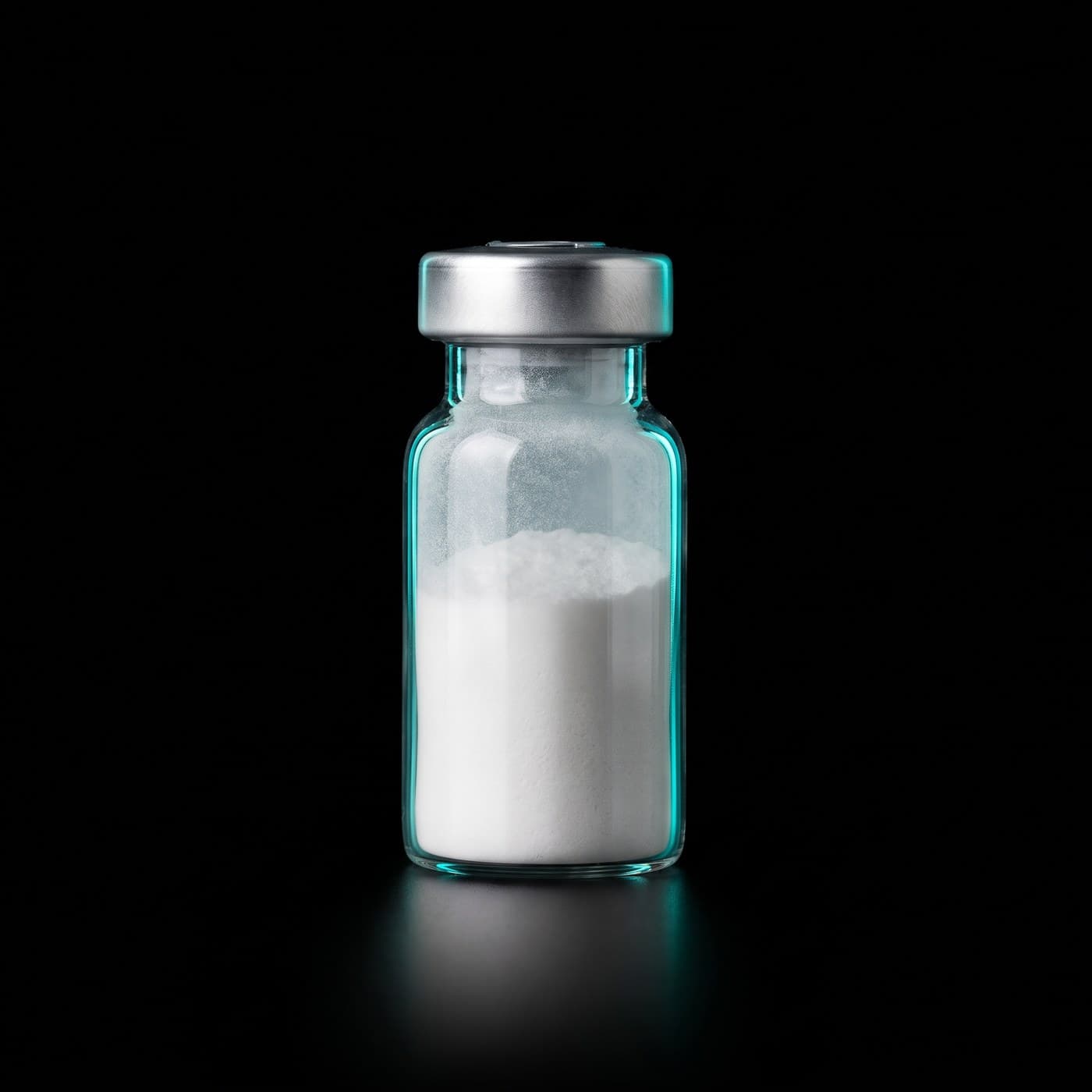
Sermorelin
The amidated 1-29 fragment of human growth-hormone-releasing hormone, historically used as a diagnostic agent for pituitary growth-hormone reserve.
- Purity
- 99.2%
- Lot
- PU-02AD
- CAS
- 86168-78-7
- MW
- 3357.93 g/mol
- Format
- Lyophilized powder
- Third-party tested
- Discreet packaging
- Same-day shipping
- Encrypted checkout
For research use only. Not for human consumption.
Mechanism of Action
Sermorelin is GRF(1-29)NH2, the amidated N-terminal 29 residues of human growth-hormone-releasing factor. A 1992 study in the Journal of Medicinal Chemistry measured the affinity of this fragment and its analogues for GRF binding sites, establishing that the truncated sequence retains receptor recognition.
Its short duration of action is a function of enzymatic clearance. Published work has identified dipeptidyl peptidase IV activity at the intestinal brush border as a route of degradation and has examined plasma-protein interactions and PEGylation as strategies for extending exposure.
Research Findings
The compound has an established diagnostic literature: a 1986 European Journal of Pediatrics report and a 1999 BioDrugs review describe its use in testing pituitary growth-hormone reserve in children with idiopathic growth hormone deficiency.
A 2006 review in Clinical Interventions in Aging examined the argument for GHRH-analogue approaches to adult-onset growth hormone insufficiency. Formulation work has focused on delivery and on stabilising the peptide against peptidase cleavage.
Storage & Reconstitution
Sealed lyophilized vials are stored in the dark. The peptide-formulation literature regards the dry solid as the stable state and the solution as the fragile one: refrigeration at 2-8 degrees C is standard for short holding periods, and minus 20 degrees C or colder for long-term storage. Vials are brought to room temperature before opening so that atmospheric moisture does not condense onto the cold solid.
For reconstitution, the diluent is added slowly down the inner wall of the vial rather than directly onto the cake, and the vial is swirled rather than shaken - agitation at an air-liquid interface is a well-documented driver of peptide aggregation. The solid should dissolve to a clear, particle-free solution; persistent cloudiness or visible particulate indicates the material should not be used.
Reconstituted solution is held at 2-8 degrees C and protected from light. Freeze-thaw cycling is the single most avoidable cause of loss, so where a solution must be frozen it is aliquoted first into single-use volumes. Working aliquots are labelled with the lot number so that any result can be traced back to the certificate of analysis for that lot.
- Physical form
- Lyophilized powder, sealed vial
- Sealed storage
- 2-8 C short term / -20 C long term
- Reconstituted
- 2-8 C, protected from light
- Diluent
- Bacteriostatic water, added down the vial wall
- Avoid
- Shaking, freeze-thaw cycling, direct light
Handling summary
References
Every entry below links to its PubMed record. Publication is not endorsement: several of these papers report limitations, negative findings or adverse events, and they are listed for that reason.
- [1]Sermorelin: a better approach to management of adult-onset growth hormone insufficiency?(opens PubMed in a new tab)
Clin Interv Aging · 2006 · PMID 18046908
- [2]PEGylation of growth hormone-releasing hormone (GRF) analogues(opens PubMed in a new tab)
Adv Drug Deliv Rev · 2003 · PMID 14499707
- [3]
- [4]
- [5]
- [6]Interactions of GRF(1-29)NH2 with plasma proteins and their effects on the release of the peptide from a PLAGA matrix(opens PubMed in a new tab)
J Control Release · 2005 · PMID 15987661