
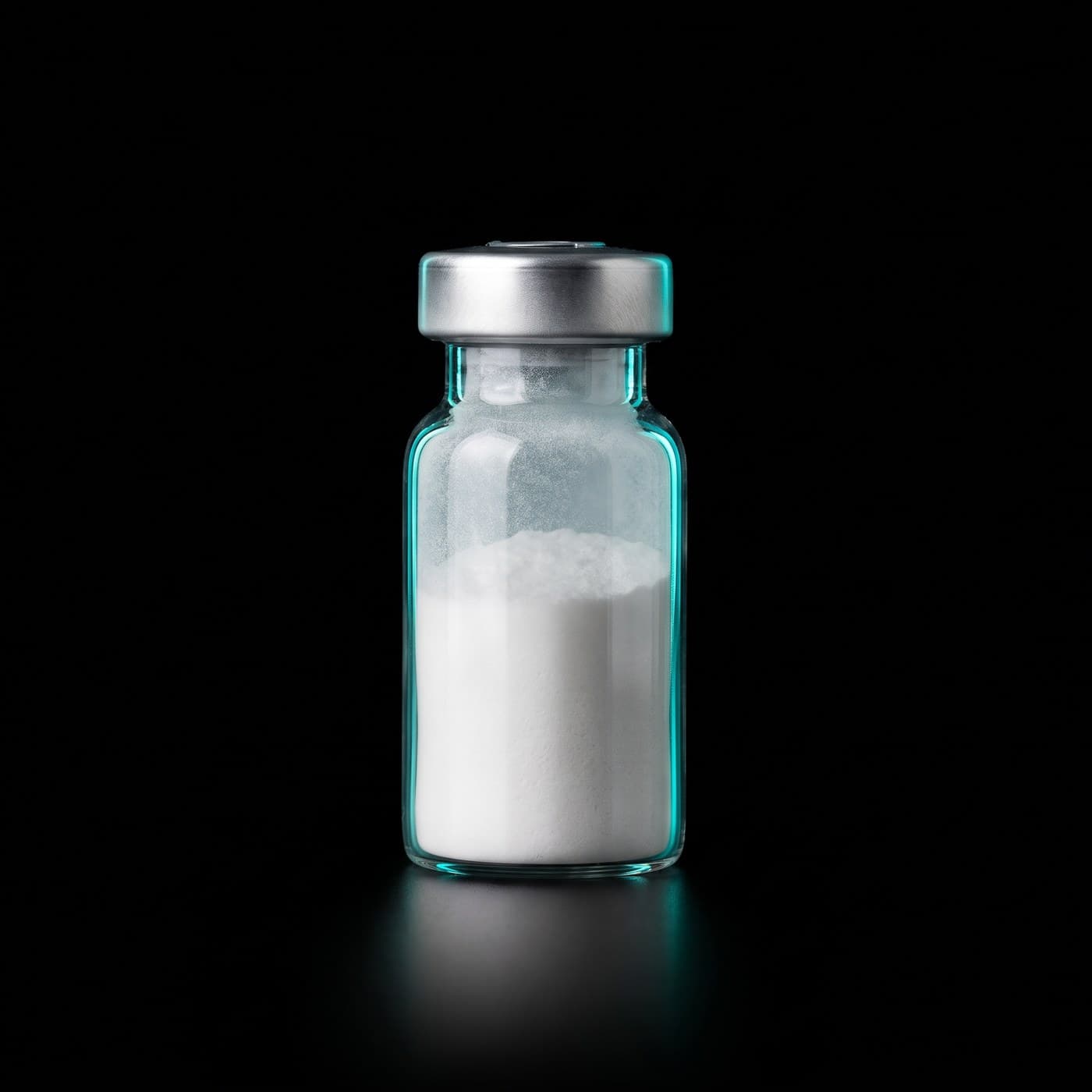
TB500
A synthetic peptide related to thymosin beta-4, the principal actin-sequestering protein of mammalian cells, studied for its role in cytoskeletal dynamics and tissue repair.
- Purity
- 99.2%
- Lot
- PU-B702
- CAS
- 77591-33-4
- MW
- 4963.44 g/mol
- Format
- Lyophilized powder
- Third-party tested
- Discreet packaging
- Same-day shipping
- Encrypted checkout
For research use only. Not for human consumption.
Mechanism of Action
Thymosin beta-4 is the principal G-actin-sequestering peptide in mammalian cells. Its characterised molecular function is to bind actin monomers and hold them in an unpolymerised pool, which regulates the availability of actin for filament assembly and therefore cell motility. Structural work has described how binding changes the conformation and dynamics of the actin monomer itself.
Beyond actin sequestration, the beta-thymosin literature has examined roles in angiogenesis, corneal and cardiac repair and inflammatory regulation. Several reviews describe the family as multifunctional and note that separating the actin-binding function from the other reported activities remains an open question.
Research Findings
Primary work has characterised the actin-binding mode biophysically and compared thymosin beta-4 with thymosin beta-10. Animal studies collected in the Annals of the New York Academy of Sciences series examined tissue-repair and regeneration endpoints across several organ systems.
Subsequent reports extended the model set to ocular surface, cardiac and sepsis contexts, and a 2026 histopathological study examined BPC-157 and TB-500 together in a rat Achilles tendon model. Clinical translation of the peptide has remained limited.
Storage & Reconstitution
Sealed lyophilized vials are stored in the dark. The peptide-formulation literature regards the dry solid as the stable state and the solution as the fragile one: refrigeration at 2-8 degrees C is standard for short holding periods, and minus 20 degrees C or colder for long-term storage. Vials are brought to room temperature before opening so that atmospheric moisture does not condense onto the cold solid. Beta-thymosins are highly charged and freely water-soluble; the handling literature emphasises avoiding repeated freeze-thaw of the reconstituted solution rather than solubility problems.
For reconstitution, the diluent is added slowly down the inner wall of the vial rather than directly onto the cake, and the vial is swirled rather than shaken - agitation at an air-liquid interface is a well-documented driver of peptide aggregation. The solid should dissolve to a clear, particle-free solution; persistent cloudiness or visible particulate indicates the material should not be used.
Reconstituted solution is held at 2-8 degrees C and protected from light. Freeze-thaw cycling is the single most avoidable cause of loss, so where a solution must be frozen it is aliquoted first into single-use volumes. Working aliquots are labelled with the lot number so that any result can be traced back to the certificate of analysis for that lot.
- Physical form
- Lyophilized powder, sealed vial
- Sealed storage
- 2-8 C short term / -20 C long term
- Reconstituted
- 2-8 C, protected from light
- Diluent
- Bacteriostatic water, added down the vial wall
- Avoid
- Shaking, freeze-thaw cycling, direct light
Handling summary
References
Every entry below links to its PubMed record. Publication is not endorsement: several of these papers report limitations, negative findings or adverse events, and they are listed for that reason.
- [1]beta-Thymosins(opens PubMed in a new tab)
Ann N Y Acad Sci · 2007 · PMID 17468232
- [2]Thymosin β4: a multi-functional regenerative peptide. Basic properties and clinical applications(opens PubMed in a new tab)
Expert Opin Biol Ther · 2012 · PMID 22074294
- [3]The beta-thymosin enigma(opens PubMed in a new tab)
Ann N Y Acad Sci · 2007 · PMID 17495248
- [4]Thymosin beta 4 regulation of actin in sepsis(opens PubMed in a new tab)
Expert Opin Biol Ther · 2018 · PMID 29508629
- [5]Thymosin beta 4 and the eye: the journey from bench to bedside(opens PubMed in a new tab)
Expert Opin Biol Ther · 2018 · PMID 30063853
- [6]Cardioprotection by Thymosin Beta 4(opens PubMed in a new tab)
Vitam Horm · 2016 · PMID 27450736