
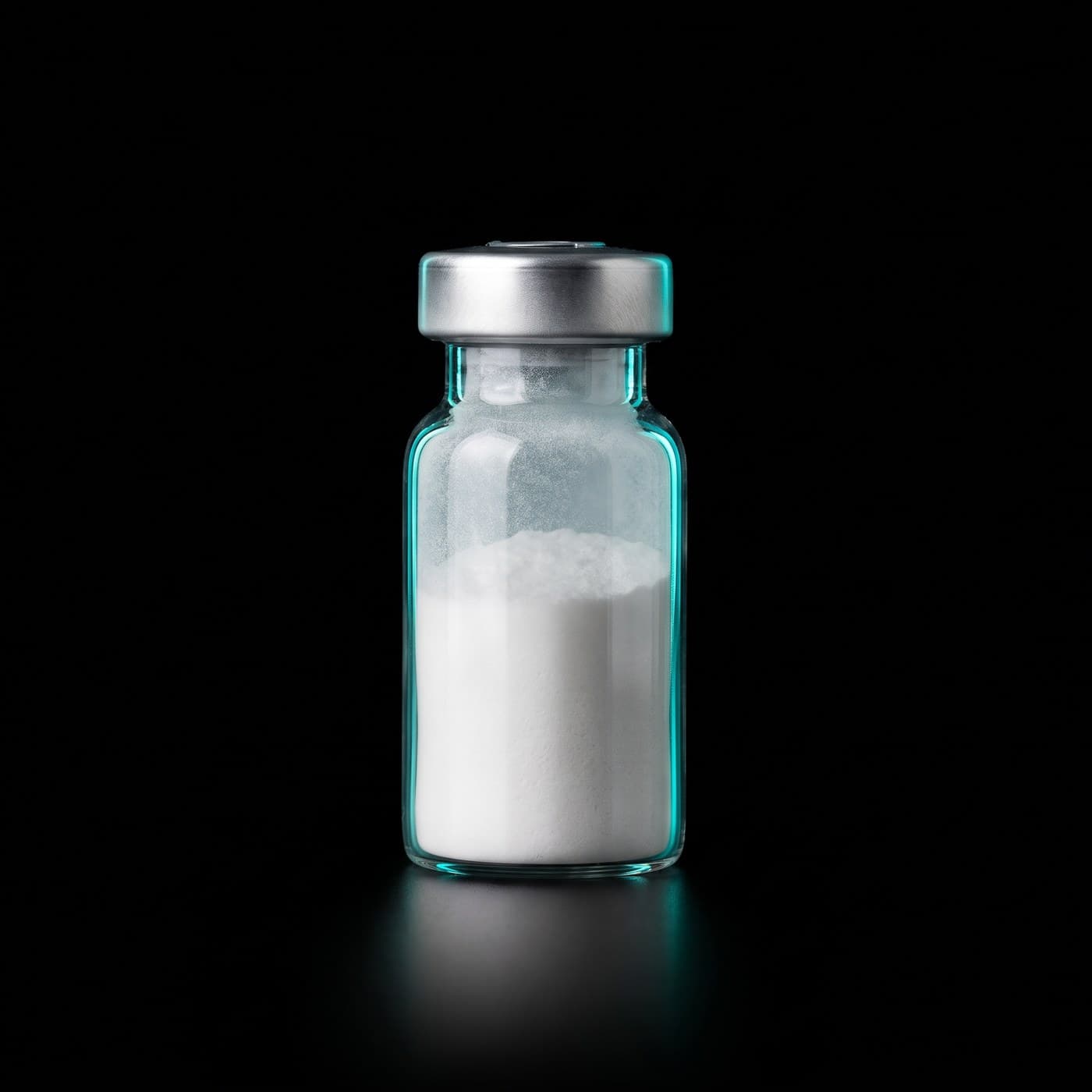
Tesamorelin
A trans-3-hexenoyl-modified GHRH(1-44) analogue with an established regulatory and clinical literature in HIV-associated lipodystrophy.
- Purity
- 99.2%
- Lot
- PU-FD55
- CAS
- 218949-48-5
- MW
- 5135.90 g/mol
- Format
- Lyophilized powder
- Third-party tested
- Discreet packaging
- Same-day shipping
- Encrypted checkout
For research use only. Not for human consumption.
Mechanism of Action
Tesamorelin is a synthetic analogue of human growth-hormone-releasing factor carrying an N-terminal trans-3-hexenoyl modification, which protects the molecule from rapid enzymatic cleavage while preserving GHRH receptor activity. It therefore acts on the same pituitary receptor as the shorter GHRH fragments but with greater metabolic stability.
Unusually for this class, its downstream biology has been examined at the tissue level: hepatic transcriptomic and targeted proteomic studies have profiled the pathways that respond in the setting studied, rather than reporting hormone concentrations alone.
Research Findings
The compound has a full clinical development literature in HIV-associated lipodystrophy, reviewed in Drugs in 2011 and in the Annals of Pharmacotherapy in 2012, with a 2009 pharmacology review in Expert Opinion on Investigational Drugs.
Later work published in AIDS, JCI Insight and Scientific Reports examined hepatic transcriptomic signatures, proteomic response pathways and outcomes in participants receiving integrase inhibitors. This is one of the better-documented peptides in the catalogue.
Storage & Reconstitution
Sealed lyophilized vials are stored in the dark. The peptide-formulation literature regards the dry solid as the stable state and the solution as the fragile one: refrigeration at 2-8 degrees C is standard for short holding periods, and minus 20 degrees C or colder for long-term storage. Vials are brought to room temperature before opening so that atmospheric moisture does not condense onto the cold solid.
For reconstitution, the diluent is added slowly down the inner wall of the vial rather than directly onto the cake, and the vial is swirled rather than shaken - agitation at an air-liquid interface is a well-documented driver of peptide aggregation. The solid should dissolve to a clear, particle-free solution; persistent cloudiness or visible particulate indicates the material should not be used.
Reconstituted solution is held at 2-8 degrees C and protected from light. Freeze-thaw cycling is the single most avoidable cause of loss, so where a solution must be frozen it is aliquoted first into single-use volumes. Working aliquots are labelled with the lot number so that any result can be traced back to the certificate of analysis for that lot.
- Physical form
- Lyophilized powder, sealed vial
- Sealed storage
- 2-8 C short term / -20 C long term
- Reconstituted
- 2-8 C, protected from light
- Diluent
- Bacteriostatic water, added down the vial wall
- Avoid
- Shaking, freeze-thaw cycling, direct light
Handling summary
References
Every entry below links to its PubMed record. Publication is not endorsement: several of these papers report limitations, negative findings or adverse events, and they are listed for that reason.
- [1]Tesamorelin: a growth hormone-releasing factor analogue for HIV-associated lipodystrophy(opens PubMed in a new tab)
Ann Pharmacother · 2012 · PMID 22298602
- [2]Tesamorelin, a human growth hormone releasing factor analogue(opens PubMed in a new tab)
Expert Opin Investig Drugs · 2009 · PMID 19243281
- [3]Tesamorelin: a review of its use in the management of HIV-associated lipodystrophy(opens PubMed in a new tab)
Drugs · 2011 · PMID 21668043
- [4]Tesamorelin update(opens PubMed in a new tab)
BETA · 2010 · PMID 21591600
- [5]Tesamorelin improves fat quality independent of changes in fat quantity(opens PubMed in a new tab)
AIDS · 2021 · PMID 33756511
- [6]Effects of tesamorelin on hepatic transcriptomic signatures in HIV-associated NAFLD(opens PubMed in a new tab)
JCI Insight · 2020 · PMID 32701508