
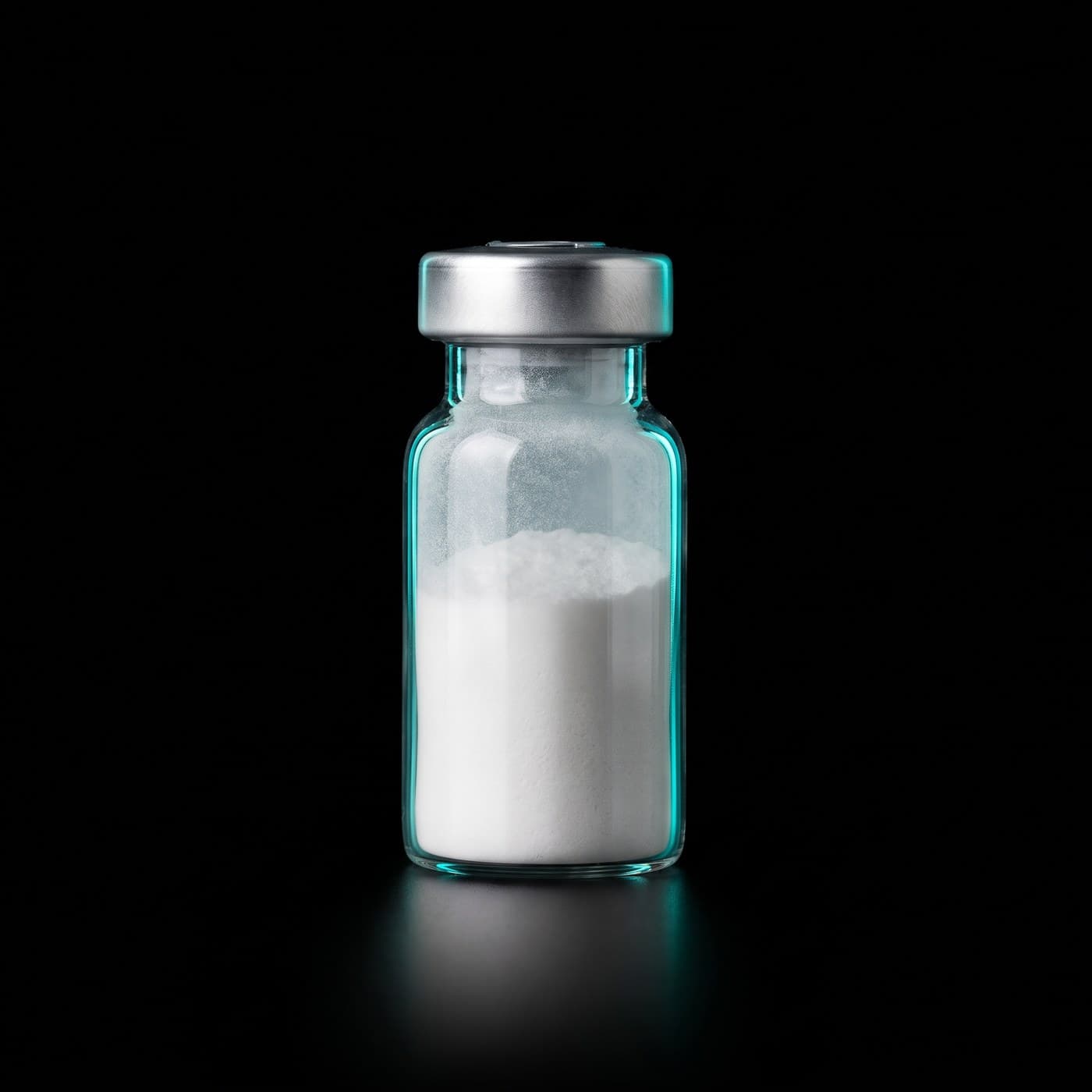
Tirzepatide
A dual GIP and GLP-1 receptor agonist with a completed regulatory development programme and a large randomised-trial literature.
- Purity
- 99.2%
- Lot
- PU-AA42
- CAS
- 2023788-19-2
- MW
- 4813.45 g/mol
- Format
- Lyophilized powder
- Third-party tested
- Discreet packaging
- Same-day shipping
- Encrypted checkout
For research use only. Not for human consumption.
Mechanism of Action
Tirzepatide is a single peptide with agonist activity at both the GIP and GLP-1 receptors. A 2020 study in JCI Insight characterised it as an imbalanced and biased dual agonist - it does not engage the two receptors equally, and its signalling bias at each differs from that of the native ligands.
That asymmetry, rather than simple dual occupancy, is the mechanistic account the literature offers for its distinct profile. A 2022 Cardiovascular Diabetology review sets out the co-agonist rationale for type 2 diabetes.
Research Findings
The randomised-trial literature is large and published in general medical journals: SURPASS-1 in the Lancet in 2021, a JAMA trial adding the agent to titrated insulin glargine in 2022, and SURPASS-6 against insulin lispro in 2023.
Later work has examined heart failure with preserved ejection fraction in JAMA, anti-inflammatory effects in a 2026 systematic review, and interaction with oral hormonal contraception - the last a practical pharmacokinetic consideration for study design.
Storage & Reconstitution
Sealed lyophilized vials are stored in the dark. The peptide-formulation literature regards the dry solid as the stable state and the solution as the fragile one: refrigeration at 2-8 degrees C is standard for short holding periods, and minus 20 degrees C or colder for long-term storage. Vials are brought to room temperature before opening so that atmospheric moisture does not condense onto the cold solid.
For reconstitution, the diluent is added slowly down the inner wall of the vial rather than directly onto the cake, and the vial is swirled rather than shaken - agitation at an air-liquid interface is a well-documented driver of peptide aggregation. The solid should dissolve to a clear, particle-free solution; persistent cloudiness or visible particulate indicates the material should not be used.
Reconstituted solution is held at 2-8 degrees C and protected from light. Freeze-thaw cycling is the single most avoidable cause of loss, so where a solution must be frozen it is aliquoted first into single-use volumes. Working aliquots are labelled with the lot number so that any result can be traced back to the certificate of analysis for that lot.
- Physical form
- Lyophilized powder, sealed vial
- Sealed storage
- 2-8 C short term / -20 C long term
- Reconstituted
- 2-8 C, protected from light
- Diluent
- Bacteriostatic water, added down the vial wall
- Avoid
- Shaking, freeze-thaw cycling, direct light
Handling summary
References
Every entry below links to its PubMed record. Publication is not endorsement: several of these papers report limitations, negative findings or adverse events, and they are listed for that reason.
- [1]
- [2]Tirzepatide is an imbalanced and biased dual GIP and GLP-1 receptor agonist(opens PubMed in a new tab)
JCI Insight · 2020 · PMID 32730231
- [3]
- [4]The impact of tirzepatide and glucagon-like peptide 1 receptor agonists on oral hormonal contraception(opens PubMed in a new tab)
J Am Pharm Assoc (2003) · 2024 · PMID 37940101
- [5]
- [6]