
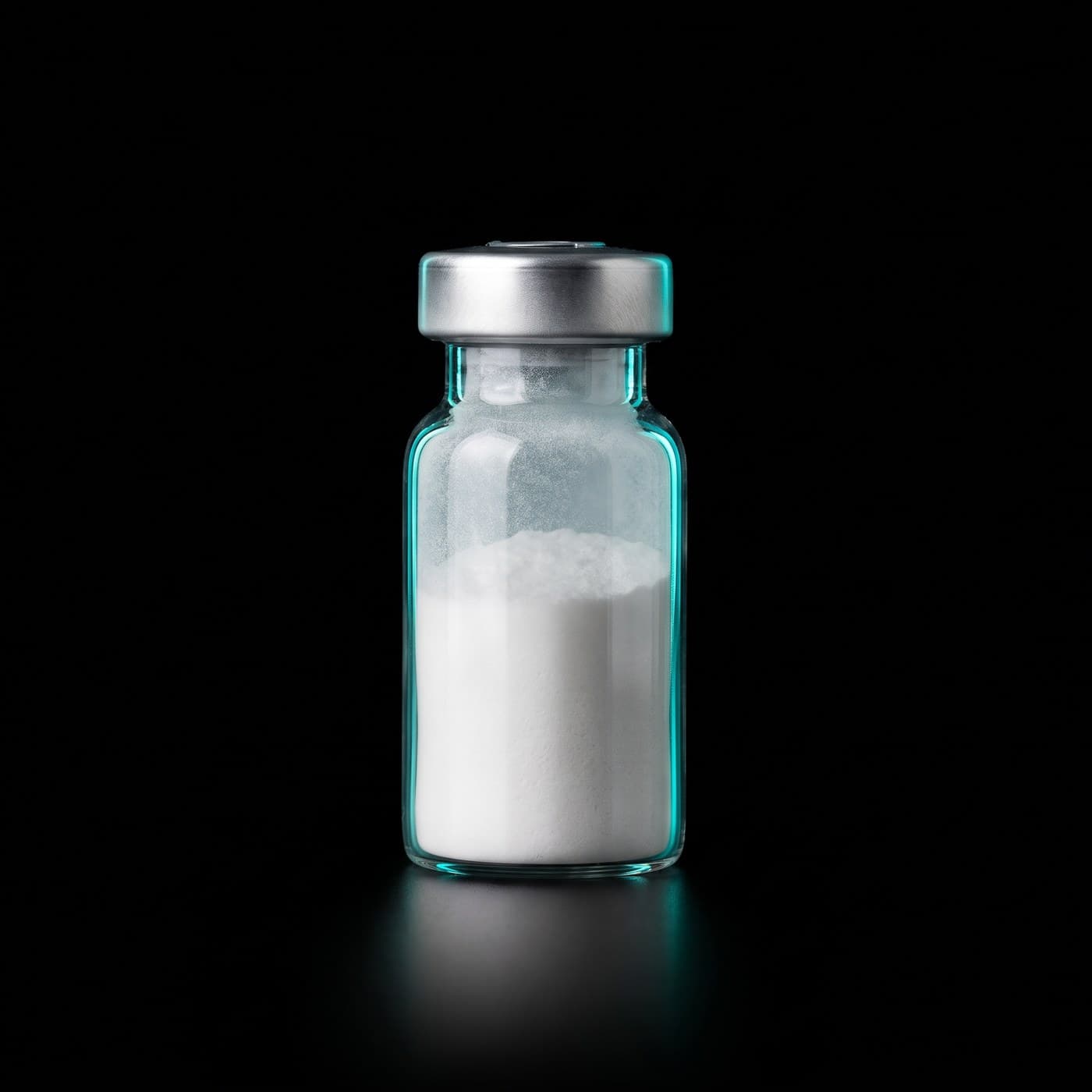
VIP
A 28-residue member of the secretin/glucagon peptide superfamily acting at the VPAC1 and VPAC2 receptors.
- Purity
- 99.2%
- Lot
- PU-775D
- Format
- Lyophilized powder
- Third-party tested
- Discreet packaging
- Same-day shipping
- Encrypted checkout
For research use only. Not for human consumption.
Mechanism of Action
Vasoactive intestinal peptide is a 28-residue peptide of the secretin/glucagon superfamily. It acts at two characterised G-protein-coupled receptors, VPAC1 and VPAC2, both cloned and pharmacologically profiled; the human receptor was cloned and expressed in a 1991 PNAS report.
A 2002 study in the Journal of Pharmacology and Experimental Therapeutics elucidated the VPAC1 pharmacophore across species. Receptor activation and regulation mechanisms were reviewed in Biochemical Society Transactions in 2007 and the receptor pharmacology comprehensively in the British Journal of Pharmacology in 2012.
Research Findings
Published work spans receptor expression in smooth muscle, myocardium and thymus, receptor-based tumour imaging, and immunomodulatory activity in intraepithelial lymphocytes.
Antagonist development is an active area, including 2026 work in the Journal of Biological Chemistry characterising VPAC receptor antagonists. The receptor pharmacology is well defined; applied literature is comparatively sparse.
Storage & Reconstitution
Sealed lyophilized vials are stored in the dark. The peptide-formulation literature regards the dry solid as the stable state and the solution as the fragile one: refrigeration at 2-8 degrees C is standard for short holding periods, and minus 20 degrees C or colder for long-term storage. Vials are brought to room temperature before opening so that atmospheric moisture does not condense onto the cold solid.
For reconstitution, the diluent is added slowly down the inner wall of the vial rather than directly onto the cake, and the vial is swirled rather than shaken - agitation at an air-liquid interface is a well-documented driver of peptide aggregation. The solid should dissolve to a clear, particle-free solution; persistent cloudiness or visible particulate indicates the material should not be used.
Reconstituted solution is held at 2-8 degrees C and protected from light. Freeze-thaw cycling is the single most avoidable cause of loss, so where a solution must be frozen it is aliquoted first into single-use volumes. Working aliquots are labelled with the lot number so that any result can be traced back to the certificate of analysis for that lot.
- Physical form
- Lyophilized powder, sealed vial
- Sealed storage
- 2-8 C short term / -20 C long term
- Reconstituted
- 2-8 C, protected from light
- Diluent
- Bacteriostatic water, added down the vial wall
- Avoid
- Shaking, freeze-thaw cycling, direct light
Handling summary
References
Every entry below links to its PubMed record. Publication is not endorsement: several of these papers report limitations, negative findings or adverse events, and they are listed for that reason.
- [1]Elucidation of vasoactive intestinal peptide pharmacophore for VPAC(1) receptors in human, rat, and guinea pig(opens PubMed in a new tab)
J Pharmacol Exp Ther · 2002 · PMID 11907155
- [2]Vasoactive intestinal peptide receptor-based imaging and treatment of tumors (Review)(opens PubMed in a new tab)
Int J Oncol · 2014 · PMID 24481544
- [3]
- [4]The vasoactive intestinal peptide (VIP) receptor: recent data and hypothesis(opens PubMed in a new tab)
Biochimie · 1988 · PMID 2852963
- [5]Expression and function of vasoactive intestinal peptide receptors in human lower esophageal sphincter(opens PubMed in a new tab)
Ann Palliat Med · 2021 · PMID 33849096
- [6]Vasoactive intestinal peptide receptor scintigraphy in patients with pancreatic adenocarcinomas or neuroendocrine tumours(opens PubMed in a new tab)
Eur J Nucl Med · 2000 · PMID 11105825